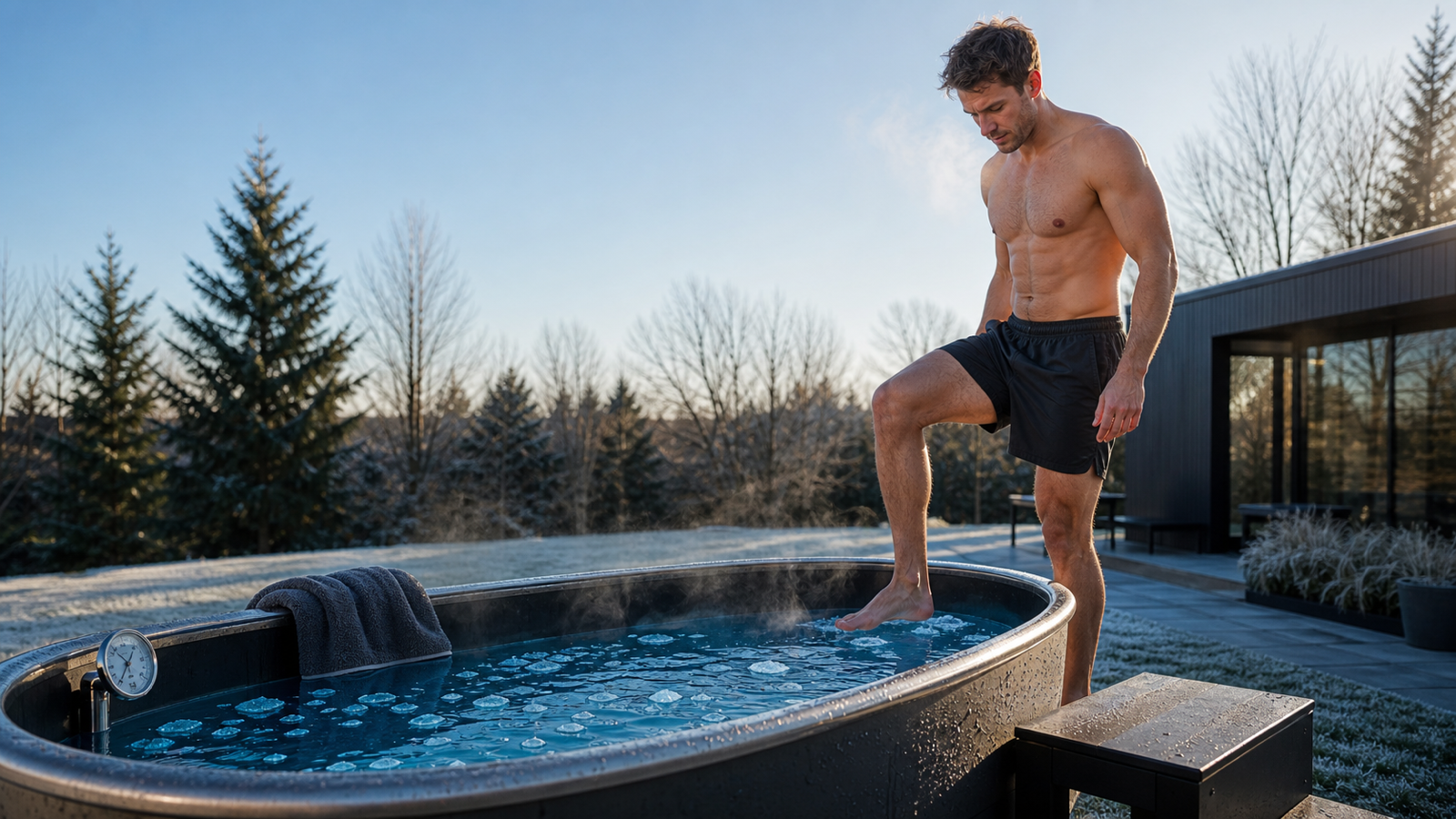
There is no single ideal cold plunge temperature or time for every beginner. The water temperature, immersion depth, experience level, breathing response, and health context all change how a session feels. A useful first session is one you can understand and repeat, not the coldest or longest session you can tolerate.
This guide walks through a practical first cold plunge: what to prepare, how to think about temperature and time, what to do when the water feels intense, and what to save afterward.
What to expect from a first cold plunge
The first moments can feel more intense than expected. Cold water can trigger a sharp breathing response, muscle tension, and an urge to get out immediately. That reaction is one reason a beginner should avoid turning the first session into a challenge.
The goal is not to prove that you can stay in. The goal is to stay oriented, keep the setup controlled, and notice how the session actually feels. If your breathing becomes difficult to control, or you feel unwell, ending the session is a sensible decision.
It also helps to separate the idea of “cold” from a specific number. A tub at 58°F / 14°C and a tub at 45°F / 7°C are both cold, but they do not create the same experience. Temperature gives your session time context.
Prepare a controlled first session
Before getting in, make the practical details easy:
- Use a stable tub or plunge setup with a clear exit.
- Keep a towel, warm clothing, and dry footwear nearby.
- Check the water temperature instead of guessing from the amount of ice.
- Tell someone where you are if you are using a new or isolated setup.
- Keep your phone or timer positioned where you can use it without reaching unsafely.
- Decide in advance that you can stop early.
Avoid making the first session harder through unnecessary variables. You do not need to combine very cold water, a long duration, breath-holding, intense exercise, or a complicated protocol to learn whether cold exposure fits your routine.
If the setup is outdoors, check the surface, lighting, weather, and path in and out of the water. A simple, familiar setup makes it easier to focus on your response rather than solving problems around the tub.
Choose a conservative temperature and time
For many beginners, a range around 50-59°F / 10-15°C is a more approachable place to learn than very cold water. The session should still be short and controlled. A lower temperature, such as 45-49°F / 7-9°C, can feel substantially more intense at the same duration.
Below 45°F / 7°C is advanced cold exposure for many people. It is not a required starting point, and colder water should not be treated as a better score.
The key beginner principle is simple: colder water usually means shorter exposure. Do not lower the temperature and increase the time on the same day. Change one variable at a time so you can tell what affected the session.
| Water temperature | Practical context | Beginner approach |
|---|---|---|
| 50-59°F / 10-15°C | Cold but often more manageable | Start conservatively and focus on control and an easy exit. |
| 45-49°F / 7-9°C | More intense at the same duration | Use shorter exposure and extra caution; do not chase the number. |
| Below 45°F / below 7°C | Advanced for many people | Do not use this as a default starting point; consider whether it is appropriate. |
For more detail, read Cold Plunge Temperature and Time and How Long Should You Stay in a Cold Plunge?.
Enter slowly and focus on breathing
The first few breaths often deserve more attention than the timer. Enter in a controlled way, keep your face out of the water, and notice whether your breathing is settling or becoming more difficult.
Do not use breath-holding or deliberate hyperventilation as a way to make the session feel more dramatic. Cold exposure already changes the breathing demand. A calm, ordinary breathing pattern is a more useful thing to practice.
If the water feels immediately overwhelming, step out. You can always try another day with a more manageable temperature or a shorter session. For more detail, see Cold Plunge Breathing.
What to do during the session
Use a timer so you are not estimating the duration from discomfort or distraction. Set a conservative goal before you enter and keep the controls easy to read. A timer should help you stay aware of time; it should never be a reason to ignore how you feel.
Keep your movements simple. There is no need to turn the session into a workout. Focus on staying steady, keeping the exit accessible, and ending the session when the plan no longer feels controlled.
After you get out, dry off and warm up gradually. Avoid treating the immediate sensation as a score or using one first session to make a sweeping conclusion about cold exposure.
What to track after your first cold plunge
Your first session is more useful when you can remember what actually happened. A short log is enough:
- date and time
- water temperature
- session duration
- whether the temperature was measured or estimated
- one short note about how controlled the session felt
- setup details that affected the session
Tracking both temperature and time matters because duration alone loses context. A two-minute session in moderately cold water is not the same as a two-minute session in much colder water. Notes can also capture details that a number cannot, such as poor sleep, post-workout timing, or a difficult entry.
Cold Plunge Timer & Log is designed for timing sessions, saving water temperature and notes, and reviewing history, stats, and streaks over time. It does not decide what is appropriate for your health situation; it helps you keep a clear record of what you chose to do.
Common beginner mistakes
The first mistake is copying a creator's temperature or duration without the surrounding context. You do not know their setup, experience, health situation, or reason for doing the session.
The second is changing everything at once. If you make the water colder, stay in longer, and add a daily schedule together, you will not know which variable made the routine harder.
The third is treating discomfort as a requirement. A session can be useful without becoming a personal endurance test. The fourth is relying on memory instead of saving the basic details. The fifth is ignoring warning signs: feeling unusually lightheaded, confused, numb, panicked, or unwell is not something to push through for a timer result.
Safety note
Cold exposure is not appropriate for everyone. This article is not medical advice, diagnosis, treatment, personalized safety guidance, or emergency support.
Cold water can stress breathing and the cardiovascular system, especially with sudden immersion, very cold temperatures, longer exposure, open water, existing medical conditions, or high cumulative stress. If you are unsure whether cold exposure is appropriate for you, speak with a qualified health professional.
Do not rely on an article, app, timer, or tracking system during an emergency.
FAQ
What is a good cold plunge temperature for beginners?
Many beginners may find 50-59°F / 10-15°C more approachable than colder water. Keep the first session short and controlled, and treat the range as general context rather than a personal prescription.
How long should a beginner cold plunge?
There is no universal beginner duration. Start conservatively and shorten the session as the water gets colder. The stopping point depends on temperature, experience, breathing, and how controlled the session feels.
What should I do during my first cold plunge?
Use a timer, keep your breathing ordinary and controlled, avoid breath-holding, keep the exit accessible, and end the session if you feel unwell or cannot stay in control.
Should I track my first cold plunge?
Yes. Save the water temperature, duration, date and time, and a short note. These details help you understand the session later without relying on memory.
Is this article medical advice?
No. It is educational guidance about planning and tracking a cold-water session. Speak with a qualified health professional if you are unsure whether cold exposure is appropriate for you.
References
- Cain MK, Brinsley J, Bennett H, Nelson M, Maher C, Singh B. The effects of cold-water immersion on health outcomes: An umbrella review. PLOS One. 2025.
- Tipton MJ, Collier N, Massey H, Corbett J, Harper M. Cold water immersion: Kill or cure? Experimental Physiology. 2017.
- Mayo Clinic Press. The science behind ice baths for recovery.