
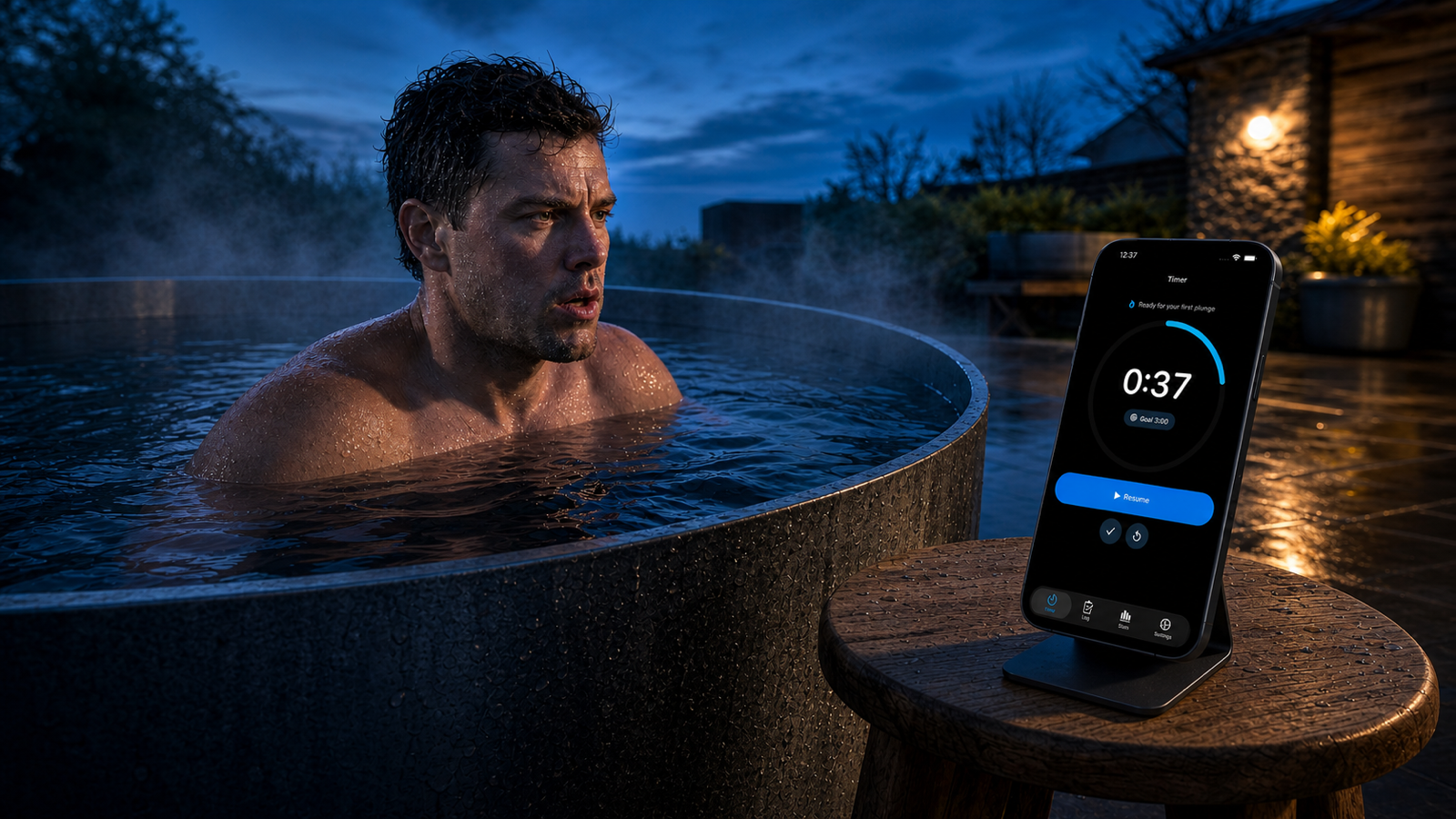
For beginners, colder water usually means shorter sessions. A two-minute cold plunge at 58 F is not the same as two minutes at 44 F. The duration may look identical in a timer, but the experience and stress of the session can be very different.
This guide gives a practical way to think about cold plunge temp and time without turning it into a rigid protocol. It is meant to help you start conservatively, track the right details, and avoid treating colder or longer as automatically better.
Why temperature and time should not be separated
Duration is easy to measure. Temperature gives that duration meaning.
If you only track time, your history can become misleading. A three-minute session in beginner-friendly cold water may feel controlled, while three minutes in colder water may feel much more intense. Without the temperature, both sessions look the same in a basic stopwatch history.
This is why a useful cold plunge timer should eventually connect timing with a log. Timing tells you what happened during one session. Tracking temperature and notes helps you understand the pattern across many sessions.
A practical beginner framework
There is no single ideal cold plunge temperature for beginners. Research uses different water temperatures, durations, immersion depth, participants, and outcomes. A beginner should treat any public range as context, not a prescription.
Still, broad ranges can help you think clearly. The table below is intentionally conservative and practical. It is not a medical protocol, and it does not replace professional guidance.
| Water temperature | How it usually feels | Beginner approach |
|---|---|---|
| 50-59 F / 10-15 C | Cold, but often more manageable for beginners | Start here if you are new, keep sessions short, and focus on control. |
| 45-49 F / 7-9 C | More intense and less forgiving | Use shorter exposure and extra caution. Do not jump here just to chase a number. |
| Below 45 F / below 7 C | Advanced cold exposure for many people | Use extra caution, avoid solo experimentation, and consider whether this is appropriate for you. |
If you are asking what temperature for cold plunge use makes sense, start with the mildest range that still feels meaningfully cold. You can learn more from a controlled, repeatable session than from one extreme session that you do not want to repeat.
How long should you cold plunge?
There is no universal time that works for every person and every temperature. A useful beginner rule is that time should become more conservative as water gets colder.
At 50-59 F, some beginners may be able to practice short, controlled sessions and build familiarity gradually. At 45-49 F, the same duration may feel much more demanding. Below 45 F, beginners should be especially cautious because the cold is more intense and mistakes become less forgiving.
If you are unsure how to think about duration, read How Long Should You Stay in a Cold Plunge?. The short version is: start conservatively, stop early when needed, and do not use a timer as permission to ignore how your body feels.
Colder water usually means shorter sessions
This is the most important beginner concept. Temperature changes the meaning of time.
If you lower the water temperature, do not automatically keep the same session length. Change one variable at a time. If today is colder than usual, keep the time easier. If you want to test a slightly longer session, avoid also making the water colder that day.
A simple pattern is to ask three questions before you start:
- What is the water temperature?
- What is a conservative time for this temperature?
- Can I exit safely if the session feels wrong?
That is more useful than trying to copy someone else's cold plunge time from a video or social post.
Why tracking both is better than tracking duration alone
A basic stopwatch can measure one session, but it cannot explain the session later. A simple cold plunge tracker becomes more useful when it connects duration with water temperature, date, notes, and consistency.
For example, imagine two saved sessions:
- 3 minutes at 58 F, calm breathing, felt controlled
- 3 minutes at 46 F, breathing felt rushed, exited stiff
Both are three-minute sessions. They should not be interpreted the same way. Temperature and notes make the record honest.
Cold Plunge Timer & Log is built around this practical idea: time the session, save the water temperature, add short notes, and review your history without needing a spreadsheet. The app mention belongs here because this is exactly where a focused log is more useful than a timer alone.
Common beginner mistakes
The first mistake is chasing colder water as if it is the goal. Colder is not automatically better. A controlled session at a less extreme temperature is more useful than forcing a session that feels chaotic.
The second mistake is increasing time and lowering temperature at the same time. If the next session feels worse, you will not know which change mattered.
The third mistake is ignoring setup. A cold plunge at home, a DIY tub, an ice bath, and open water are not the same environment. Entry, exit, footing, supervision, and how quickly the water warms can all affect the session.
What to track
For a beginner, useful tracking is simple:
- duration
- water temperature
- date and time
- session type, such as cold plunge or ice bath
- short notes about breathing, control, and setup
- consistency or streaks over time, if that helps you review the habit
This is enough to make your history useful without turning cold exposure into a complicated dashboard. For a fuller logging framework, read How to Track Cold Plunge Sessions. For temperature context specifically, read What Temperature Should a Cold Plunge Be?.
Safety note
Cold exposure is not appropriate for everyone. This article is not medical advice, diagnosis, treatment, personalized safety guidance, or emergency support.
Cold water can stress breathing and the cardiovascular system, especially with sudden immersion, very cold temperatures, longer exposure, open water, existing medical conditions, or high cumulative stress. If you are unsure whether cold exposure is appropriate for you, speak with a qualified health professional.
Do not rely on an article, app, timer, or tracking system during an emergency.
FAQ
What is a good cold plunge temperature and time for beginners?
Many beginners may find 50-59 F, or about 10-15 C, more approachable than colder water. Time should stay conservative and change with temperature, experience, and how controlled the session feels.
Should colder water mean a shorter cold plunge?
Usually, yes. Colder water makes the same duration more intense, so beginners should generally use shorter sessions as temperature drops.
Is 45 F too cold for a beginner cold plunge?
45 F, or about 7 C, is intense for many people. Beginners should use extra caution, keep exposure shorter, and avoid treating colder water as a score.
What should I track for cold plunge temperature and time?
Track water temperature, duration, date and time, short notes, and how controlled the session felt. That makes your log more useful than tracking time alone.
Is this medical advice?
No. This article is educational only and is not medical advice, diagnosis, treatment, personalized safety guidance, or emergency support.
References
- Cain T, Brinsley J, Bennett H, Nelson M, Maher C, Singh B. Effects of cold-water immersion on health and wellbeing: A systematic review and meta-analysis. PLOS ONE. 2025.
- Machado AF, Ferreira PH, Micheletti JK, de Almeida AC, Lemes IR, Vanderlei FM, et al. Can water temperature and immersion time influence the effect of cold water immersion on muscle soreness? Sports Medicine. 2016.
- Tipton M, Bradford C. Moving in extreme environments: open water swimming in cold and warm water. Extreme Physiology & Medicine. 2014.
- Mayo Clinic Press. The science behind ice baths for recovery.
- American Heart Association. You're not a polar bear: The plunge into cold water comes with risks.