
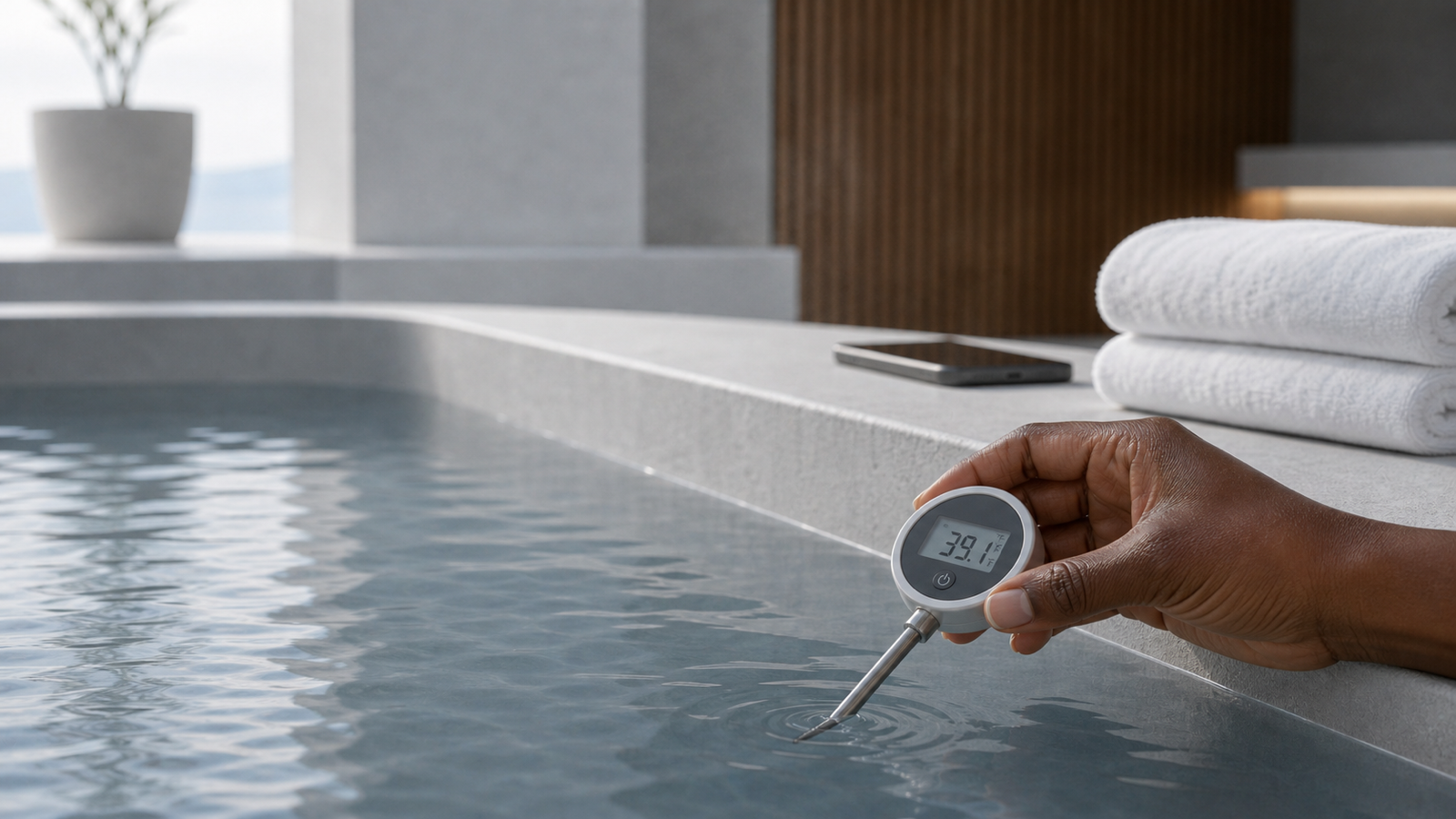
A better beginner question is not "what exact temperature is best?" It is: what temperature can you approach calmly, pair with an appropriate duration, and exit from safely?
In cold-water immersion research, temperature is never the whole story. Studies also track duration, immersion depth, timing, participant health, training status, and what outcome is being measured. That is why a cold plunge temperature that appears in a study should not be copied as a personal prescription.
What research means by cold-water immersion
A 2025 systematic review and meta-analysis on cold-water immersion and wellbeing included studies where water temperature was at or below 15 C, exposure lasted at least 30 seconds, and immersion reached at least chest level. The review also extracted protocol details such as temperature, duration, number of immersions, depth, and timing.
That matters because many online recommendations flatten cold plunging into one number. The research literature does not do that. Temperature is one variable inside a larger protocol.
Why colder is not automatically better
Colder water makes the same amount of time more demanding. It can also increase the importance of breathing control, safe entry, and safe exit.
One systematic review on cold-water immersion for muscle soreness found that water between 11 and 15 C appeared more favorable for that specific recovery outcome, with 11 to 15 minutes appearing favorable in that review. That does not mean 11 to 15 C is the best cold plunge temperature for every person, every goal, or every beginner. It means one recovery-focused body of research found a pattern inside a specific context.
The practical takeaway is simple: do not treat colder water as a score. A colder plunge that you cannot manage calmly is not automatically more useful.
Temperature and duration belong together
Cold plunge temperature and cold plunge duration should always be read together. Five minutes in milder cold water is not the same as five minutes in colder water.
For beginners, colder water usually calls for a more conservative duration. If you are unsure how long to stay in, start with the timing principles in how long should you stay in a cold plunge and treat temperature as one of the main inputs.
The useful pattern is to adjust slowly. Change one thing at a time: temperature, duration, or frequency. If you change all three at once, it becomes harder to know what your body is responding to.
A beginner-friendly temperature mindset
A beginner-friendly cold plunge temperature is one that lets you stay aware, keep breathing under control, and exit safely. That may be less cold than what you see online.
Many people think of around 50 F, or about 10 C, as clearly cold. But the right question is not whether that number sounds impressive. The right question is whether the session remains controlled for you, on that day, in that setup.
If you are new, make the first goal control rather than intensity. You can always adjust later after you understand how you respond.
Cold shock is part of the safety picture
Cold-water immersion can trigger a cold shock response. Research on open-water cold exposure describes initial immersion responses such as gasp, hyperventilation, increased heart rate, and breathing control problems, especially in unacclimated people.
A study on acute anxiety and cold shock response used 15 C water and found that anxiety was connected with components of the cold shock response. For a beginner, that supports a practical point: panic and forced exposure are poor goals.
If you cannot control your breathing, feel dizzy, feel chest pain or pressure, lose coordination, become confused, or cannot exit safely, the session should stop.
What to track with water temperature
Temperature becomes more useful when it is logged with context. At minimum, track:
- water temperature
- duration
- date and time
- short notes
- how controlled the session felt
This lets you compare sessions without relying on memory. For a simple logging framework, read how to track cold plunge sessions.
Common temperature mistakes
The first mistake is chasing the coldest possible water before you have built judgment. The second is copying someone else's temperature without knowing their experience, setup, or health context. The third is ignoring duration once you know the temperature.
A calmer approach is to record the temperature, keep the duration conservative, and notice how your body responds over time.
Safety note
This article is educational only. It is not medical advice, diagnosis, treatment, personalized safety guidance, or emergency support.
Cold exposure is not appropriate for everyone. Cold water can stress breathing and the cardiovascular system, especially with sudden immersion, colder water, longer exposure, open water, existing medical conditions, or high cumulative stress. If you are unsure whether cold exposure is appropriate for you, speak with a qualified health professional.
Do not rely on an article, timer, or tracking system during an emergency.
FAQ
What temperature should a cold plunge be?
There is no single proven best temperature for everyone. Cold-water immersion research often studies water at or below 15 C, but beginners should think about temperature together with duration, setup, experience, and safety.
Is colder water better for a cold plunge?
Not automatically. Colder water can make the same duration more stressful, especially for beginners. A controlled session at a milder cold temperature is more useful than forcing a colder session you cannot manage safely.
Should cold plunge temperature change how long I stay in?
Yes. Temperature and duration belong together. As water gets colder, the session usually deserves a more conservative duration and closer attention to breathing, coordination, and how you feel.
Is 50 F cold enough for a cold plunge?
For many people, 50 F, or about 10 C, is meaningfully cold. Whether it is appropriate depends on your experience, health context, duration, supervision, and ability to stay calm and exit safely.
What should beginners track with cold plunge temperature?
Track water temperature, duration, date, notes, and how controlled the session felt. Those details make your history more useful than temperature or time alone.
References
- Cain T, Brinsley J, Bennett H, Nelson M, Maher C, Singh B. Effects of cold-water immersion on health and wellbeing: A systematic review and meta-analysis. PLOS ONE. 2025.
- Machado AF, Ferreira PH, Micheletti JK, de Almeida AC, Lemes IR, Vanderlei FM, et al. Can water temperature and immersion time influence the effect of cold water immersion on muscle soreness? Sports Medicine. 2016.
- Moore E, Fuller JT, Bellenger CR, Saunders S, Halson SL, Nelson MJ, et al. Impact of cold-water immersion compared with passive recovery following a single bout of strenuous exercise. Sports Medicine. 2022.
- Tipton M, Bradford C. Moving in extreme environments: open water swimming in cold and warm water. Extreme Physiology & Medicine. 2014.
- Barwood MJ, Corbett J, Wagstaff CRD, McVeigh D, Thelwell RC. Acute anxiety predicts components of the cold shock response on cold water immersion. Frontiers in Psychology. 2018.
- Bleakley C, McDonough S, Gardner E, Baxter GD, Hopkins JT, Davison GW. Cold-water immersion for preventing and treating muscle soreness after exercise. Cochrane Database of Systematic Reviews. 2012.