
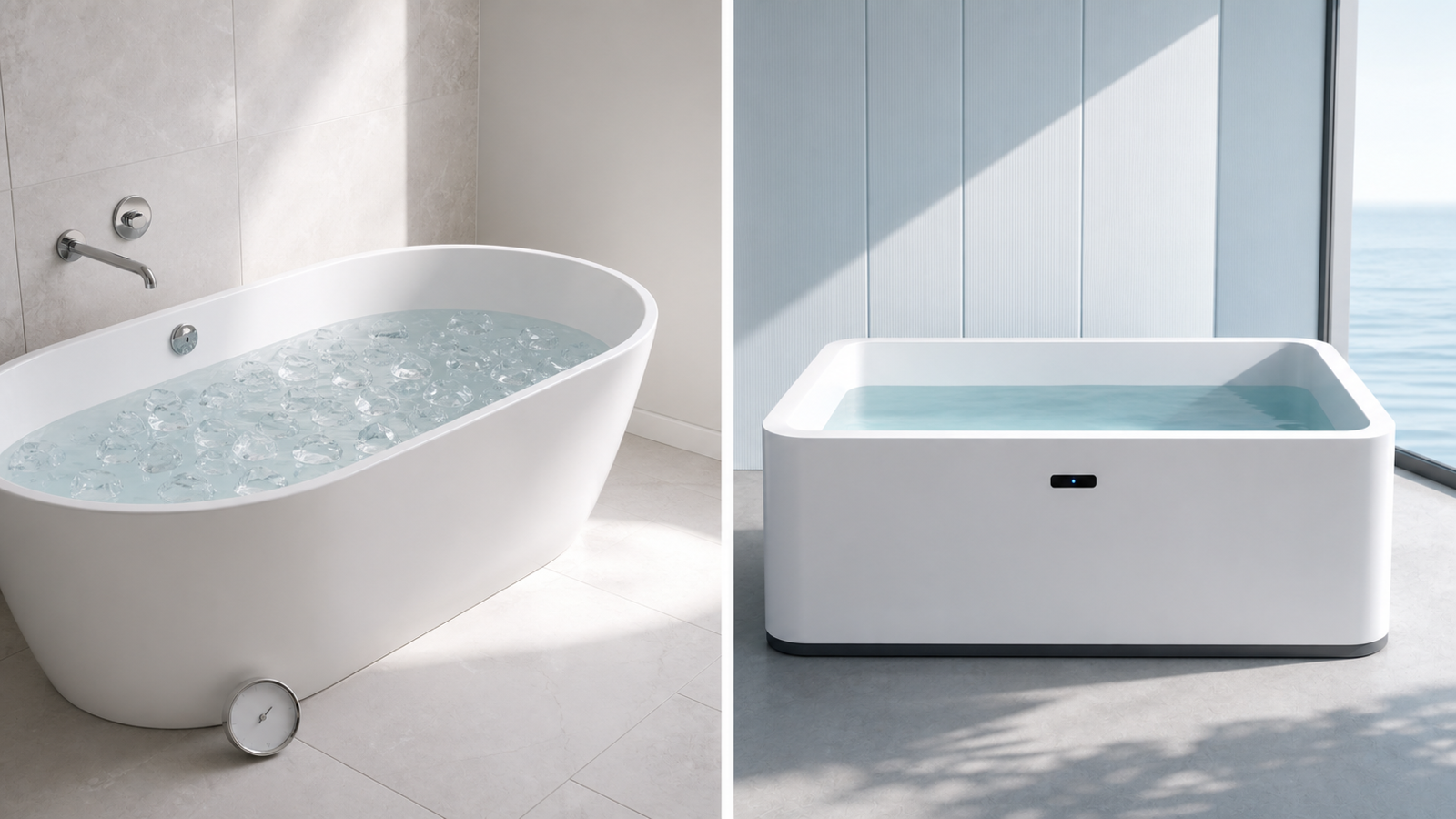
An ice bath usually describes how the water is made cold: you add ice to a tub, bath, or container. A cold plunge usually describes the cold-water session itself, often in a dedicated tub or a more repeatable cold-water setup.
For most beginners, the name matters less than the basics: how cold the water is, how long you stay in, how controlled the session feels, and whether you can repeat the routine safely.
This guide explains the practical difference between an ice bath and a cold plunge, where the terms overlap, and what to track if you use either one.
What is an ice bath?
An ice bath is a cold-water setup where ice is added to water to lower the temperature.
That setup can be very simple. Some people use a bathtub. Others use a large container, outdoor tub, stock tank, or portable bath. The common idea is the same: water plus ice creates the cold exposure.
The advantage is accessibility. You do not need a dedicated cold plunge tub to start. You can create an ice bath with basic equipment, and you can adjust the experience by changing the amount of ice, the water volume, and the time you spend in the water.
The tradeoff is control. Ice melts, water temperature changes, and the setup can be different from one session to the next. One ice bath might be much colder than another, even if you use the same tub. Room temperature, outdoor temperature, starting water temperature, amount of ice, and how long you wait before getting in can all change the result.
That is why an ice bath temperature reading is useful. Without it, you may only know that the water felt cold, not how cold it actually was.
What is a cold plunge?
A cold plunge usually refers to the act of immersing yourself in cold water. In everyday use, it often also means a dedicated cold plunge tub or a repeatable cold-water setup.
Some cold plunges are simple tubs filled with cold water. Some are insulated. Some have chillers that hold the water near a target temperature. Some are indoor, some are outdoor, and some are part of a sauna or recovery routine.
The advantage of a cold plunge setup is repeatability. If the water temperature is easier to measure or control, the session becomes easier to compare over time. A three-minute cold plunge at a known temperature tells you more than a three-minute dip where the water was simply "cold."
That repeatability is the main practical difference. A cold plunge does not automatically mean colder, better, safer, or more effective. It usually means the setup is more purpose-built and easier to repeat.
The practical difference
The easiest way to compare an ice bath and a cold plunge is to look at the setup, temperature control, repeatability, convenience, and cost.
| Factor | Ice bath | Cold plunge |
|---|---|---|
| Setup | Add ice to water in a bath, tub, or container. | Use a dedicated tub or repeatable cold-water setup. |
| Temperature control | Can vary a lot depending on ice, water volume, and timing. | Often easier to measure or hold steady, especially with a chiller. |
| Repeatability | Less predictable unless you measure temperature each time. | Usually more repeatable from session to session. |
| Convenience | Simple to start, but ice can be inconvenient. | Easier once set up, but may require more space and maintenance. |
| Cost | Usually cheaper to try. | Usually more expensive if using dedicated equipment. |
| Tracking value | Temperature and duration matter because sessions can vary. | Temperature and duration matter because repeatability makes progress easier to compare. |
Neither option is automatically better. An ice bath can be a practical starting point. A cold plunge can be more convenient if you want a routine you can repeat often.
The better choice is the one you can approach calmly, measure honestly, and use consistently without turning the routine into a production.
Is one colder than the other?
Not automatically.
An ice bath can become very cold if you add enough ice and give the water time to cool. But it can also be milder if there is less ice, more water, warmer starting water, or warmer air around the tub.
A cold plunge can also vary. A dedicated cold plunge with temperature control may hold a steady target. A simple outdoor tub may depend heavily on the weather. A lake, ocean dip, or unheated tub may change with the season.
So the useful question is not "which one is colder?" The useful question is: what is the water temperature today?
Cold-water immersion research treats temperature, duration, immersion depth, timing, and setup as important protocol details. That is a good reminder for personal routines too. Time alone does not tell the whole story. The same two minutes can feel different at different water temperatures.
If you want more detail on temperature, read what temperature should a cold plunge be.
Which is better for beginners?
For beginners, the better setup is usually the one you can make controlled and repeatable.
That might be a simple bathtub ice bath. It might be a dedicated cold plunge. It might even be starting with a cold shower before trying full immersion. The label matters less than the way you use it.
A beginner-friendly setup should make it easy to know the water temperature, start with a conservative duration, stay aware of how your body responds, and exit safely.
An ice bath can be beginner-friendly if you keep it simple, avoid chasing extreme cold, and measure the water temperature. A cold plunge can be beginner-friendly if it helps you keep the routine consistent and removes setup friction. Either one can become too intense if the water is very cold, the session is too long, or you ignore warning signs.
Do not compare your setup to someone else's highlight reel. Compare your current session to your own recent sessions.
If you are unsure about timing, read how long should you stay in a cold plunge.
What to track for either one
Whether you call it an ice bath or a cold plunge, the useful tracking fields are almost the same.
Track these first:
- duration
- water temperature
- date and time
- short notes
- how controlled the session felt
- progress or streaks over time
A basic stopwatch can tell you how long one session lasted. A simple cold plunge tracker or ice bath tracker helps you understand the pattern across sessions.
For example, a two-minute session at one temperature is not the same as a two-minute session at a colder temperature. A session after a workout may feel different from a morning session. An outdoor plunge may feel different from an indoor tub. Notes do not need to be long, but they can explain why one session felt easier or harder than another.
The simplest workflow is:
- Start the timer.
- Record the water temperature.
- Save a short note if something matters.
- Review progress over time.
Cold Plunge Timer & Log is built around that kind of lightweight routine: time the session, save the details, and see your history without turning the habit into a spreadsheet.
For a fuller tracking framework, read how to track cold plunge sessions.
Safety note
Cold exposure is not appropriate for everyone. This article is not medical advice, diagnosis, treatment, personalized safety guidance, or emergency support.
Cold water can stress breathing and the cardiovascular system, especially with sudden immersion, very cold temperatures, longer exposure, open water, existing medical conditions, or high cumulative stress. Sudden cold-water immersion can also trigger a cold shock response, including gasping and fast breathing.
If you are unsure whether cold exposure is appropriate for you, speak with a qualified health professional. Do not rely on an article, app, timer, or tracking system during an emergency.
FAQ
Is an ice bath the same as a cold plunge?
They overlap, but they are not always the same. An ice bath usually means adding ice to water to create a cold setup. A cold plunge usually refers to the cold-water session itself or a dedicated cold-water tub.
Is an ice bath colder than a cold plunge?
Not automatically. Either setup can be colder depending on the water temperature, ice, equipment, weather, and timing. Measure the water temperature instead of guessing from the name.
Can I use a cold plunge timer for an ice bath?
Yes. The same basic timer works for either one. What matters is saving the session duration and, ideally, the water temperature so the log has context.
What should I track after an ice bath or cold plunge?
Track duration, water temperature, date, short notes, and progress over time. These fields are enough for most people to understand their routine without making it complicated.
Which is better for beginners, an ice bath or a cold plunge?
The better beginner option is the one you can approach calmly, measure, repeat, and exit safely. A simple ice bath can work well. A dedicated cold plunge can also help if it makes the routine easier to repeat.
Is this medical advice?
No. This article is educational only. It is not medical advice, diagnosis, treatment, personalized safety guidance, or emergency support.
References
- Cain T, Brinsley J, Bennett H, Nelson M, Maher C, Singh B. Effects of cold-water immersion on health and wellbeing: A systematic review and meta-analysis. PLOS ONE. 2025.
- Tipton M, Bradford C. Moving in extreme environments: open water swimming in cold and warm water. Extreme Physiology & Medicine. 2014.
- Mayo Clinic Press. Cold Plunge Benefits: The Science Behind Ice Baths for Recovery. 2024.