
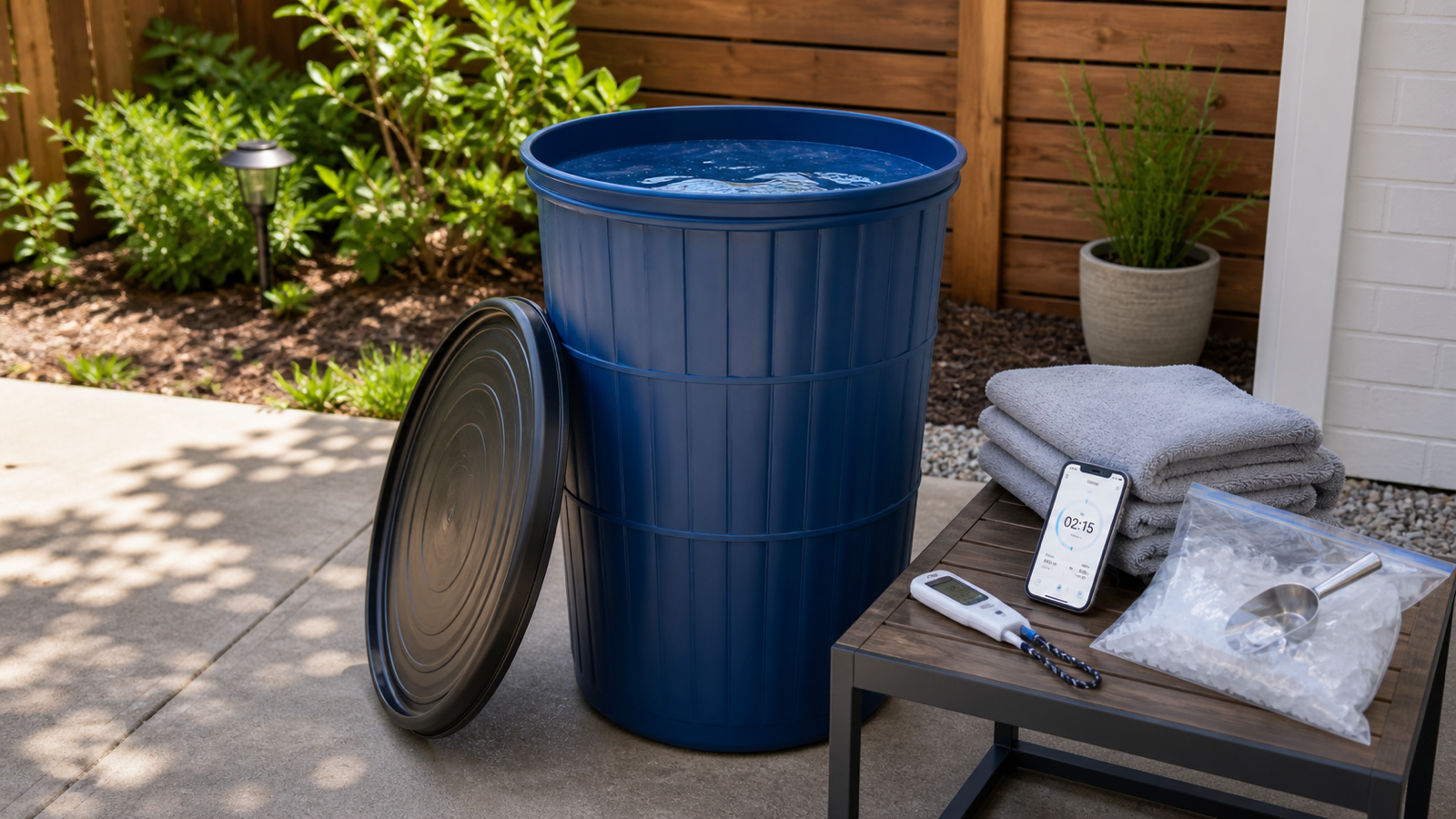
If you are using a DIY cold plunge, the most useful thing to track before upgrading is not only how long you stay in the water. Track water temperature, duration, setup details, short notes, and consistency over time.
That record gives you a clearer answer than memory. A DIY setup can change from session to session because the amount of ice, starting water temperature, tub size, room temperature, weather, and timing all affect the experience. Before you spend money on a dedicated plunge tub, chiller, or more permanent setup, it helps to know what is actually limiting your routine.
This guide is not about building the perfect cold plunge. It is about understanding the one you already have.
Why a DIY cold plunge is harder to judge than it looks
A dedicated cold plunge can be repeatable. A DIY cold plunge is usually more variable.
That does not make it bad. A bathtub, stock tank, inflatable tub, or simple ice bath can be enough for many people. The challenge is that DIY setups often hide the details that matter. You might remember that one session felt very cold, but not whether the water was colder, the session was longer, you used more ice, or you were simply more tired that day.
Research on cold-water immersion often treats temperature, duration, timing, and frequency as important protocol variables. For a personal routine, the practical version is simple: if the setup changes, the session changes too.
That is why tracking matters before upgrading. You are not trying to turn cold plunging into a spreadsheet. You are trying to separate real problems from vague frustration.
The simple DIY cold plunge tracking framework
Start with six fields:
| Field | Why it matters |
|---|---|
| Duration | Shows how long the session lasted. |
| Water temperature | Gives context to the duration. |
| Setup type | Separates bathtub, stock tank, inflatable tub, or dedicated tub sessions. |
| Ice or cooling method | Helps you understand the cost and effort of getting the water cold. |
| Short notes | Captures anything unusual without overthinking it. |
| Consistency | Shows whether the setup fits your real schedule. |
You do not need a complicated log. A useful DIY cold plunge tracker should make it easy to answer basic questions:
- How cold was the water?
- How long did I stay in?
- Was the setup easy enough to repeat?
- Did I need a lot of ice?
- Did the session feel controlled?
- Am I actually doing this consistently?
Those answers matter more than a perfect-looking setup.
Track water temperature first
For DIY cold plunges, water temperature is usually the most important detail to record.
Duration without temperature can be misleading. Two minutes in one DIY ice bath may not feel like two minutes in another. The water might be warmer at the start, colder after the ice melts, or uneven if the tub has not mixed well. A thermometer gives the session context.
You do not need to chase the coldest possible number. In fact, colder is not automatically better. For beginners, a useful goal is to understand your own range before making the routine more intense or expensive.
Track:
- starting water temperature
- approximate temperature when you enter
- whether the water warmed or cooled noticeably
- whether the setup was unusually cold compared with normal
If the temperature is all over the place, a dedicated chiller or better setup may eventually make sense. But the data should tell you that, not guesswork.
Track duration with context
Time is still the core record. A cold plunge timer tells you how long the session lasted, but the number only becomes useful when paired with context.
For example:
2:00 at 58 Fis different from2:00 at 44 F3:00 after saunais different from3:00 first thing in the morning1:30 felt controlledis different from1:30 felt rushed
The purpose is not to rank sessions. The purpose is to understand them.
This is where a focused timer and log can be useful. Cold Plunge Timer & Log is built around the basic workflow: start a cold plunge or ice bath timer, save the water temperature, add a short note, and review progress over time.
Track setup friction
Before upgrading, track how much effort your DIY setup actually takes.
The limiting factor may not be cold tolerance. It may be friction. Buying ice, filling the tub, cleaning up water, waiting for the temperature to drop, or storing the setup can be the reason the habit does not stick.
Useful setup notes include:
- how much ice you used
- how long the setup took
- whether cleanup was annoying
- whether the water temperature was repeatable
- whether the setup was available when you wanted it
- whether the location felt practical
If you keep missing sessions because the setup is too much work, that is useful information. It may mean you need a simpler routine, a different schedule, or eventually a more repeatable cold plunge setup.
If the DIY version is easy to repeat, you may not need to upgrade yet.
Track consistency, not just intensity
A DIY cold plunge can make people focus on the dramatic parts: more ice, colder water, longer sessions, bigger upgrades.
A better question is whether the routine is consistent enough to be useful for you.
Track simple consistency:
- sessions per week
- longest gap between sessions
- usual time of day
- setup type used most often
- whether you skipped because setup was inconvenient
This helps you avoid upgrading for the wrong reason. A more expensive setup will not automatically create a routine. If the real issue is schedule, location, or motivation, better equipment may not solve it.
On the other hand, if you are already consistent and the DIY setup is the bottleneck, an upgrade may be more reasonable.
Signs you may be ready to upgrade
Your tracking record can show upgrade signals.
You may be ready to upgrade if:
- the water temperature is too inconsistent for the routine you want
- buying ice is becoming expensive or inconvenient
- setup and cleanup are causing you to skip sessions
- you want a more repeatable water temperature
- you are consistent enough that the setup is worth improving
- you want a cleaner way to review history, stats, and streaks
You may not need to upgrade if:
- your current setup is easy to repeat
- the temperature range is acceptable for your goals
- you only cold plunge occasionally
- the main issue is scheduling, not equipment
- you are still figuring out whether the routine fits your life
The point is not to delay every purchase. The point is to make the purchase solve a real problem.
What not to overtrack
Do not track so much that the routine becomes annoying.
For most people, these are optional:
- exact pounds of ice every time
- long mood notes
- complicated scoring systems
- daily performance ratings
- comparisons with other people's routines
Short notes are enough:
first DIY stock tank sessionused one bag of icetemperature dropped slowlycleanup took too longfelt controlledskipped yesterday because setup was inconvenient
That kind of note is practical. It helps you remember what happened without turning the routine into a second job.
Safety note
Cold exposure is not appropriate for everyone. This article is not medical advice, diagnosis, treatment, personalized safety guidance, or emergency support.
Cold water can stress breathing and the cardiovascular system, especially with sudden immersion, very cold temperatures, longer exposure, open water, existing medical conditions, or high cumulative stress. DIY setups can also add practical risks if they involve unstable containers, unsafe surfaces, poor drainage, or electrical equipment near water.
If you are unsure whether cold exposure is appropriate for you, speak with a qualified health professional. Do not rely on an article, app, timer, or tracking system during an emergency.
FAQ
What should I track in a DIY cold plunge?
Track duration, water temperature, setup type, ice or cooling method, short notes, and consistency. These details help you understand whether your DIY setup is repeatable.
Is a DIY cold plunge worth it?
A DIY cold plunge can be worth it if it is easy enough to repeat and gives you a setup you can use consistently. Tracking helps you decide whether the setup is working before you spend more money.
Should I track water temperature every time?
For a DIY setup, yes, if possible. Water temperature can vary a lot depending on ice, water volume, room temperature, and timing, so it gives important context to session duration.
When should I upgrade from a DIY cold plunge?
Consider upgrading when your current setup is consistent enough to justify it, but the water temperature, ice cost, setup time, cleanup, or repeatability are limiting the routine.
Can I use a cold plunge tracker for ice baths?
Yes. Ice baths and cold plunges use the same basic tracking fields: duration, water temperature, date, setup notes, and progress over time.
Is this medical advice?
No. This article is educational only. Cold exposure can carry risks, and people with health concerns should speak with a qualified health professional.
References
- Cain T, Brinsley J, Bennett H, Nelson M, Maher C, Singh B. Effects of cold-water immersion on health and wellbeing: A systematic review and meta-analysis. 2025.
- Golden F, Tipton M, Scott R. Immersion, near-drowning and drowning. British Journal of Anaesthesia. 1997.
- Mayo Clinic Press. The science behind ice baths for recovery.