
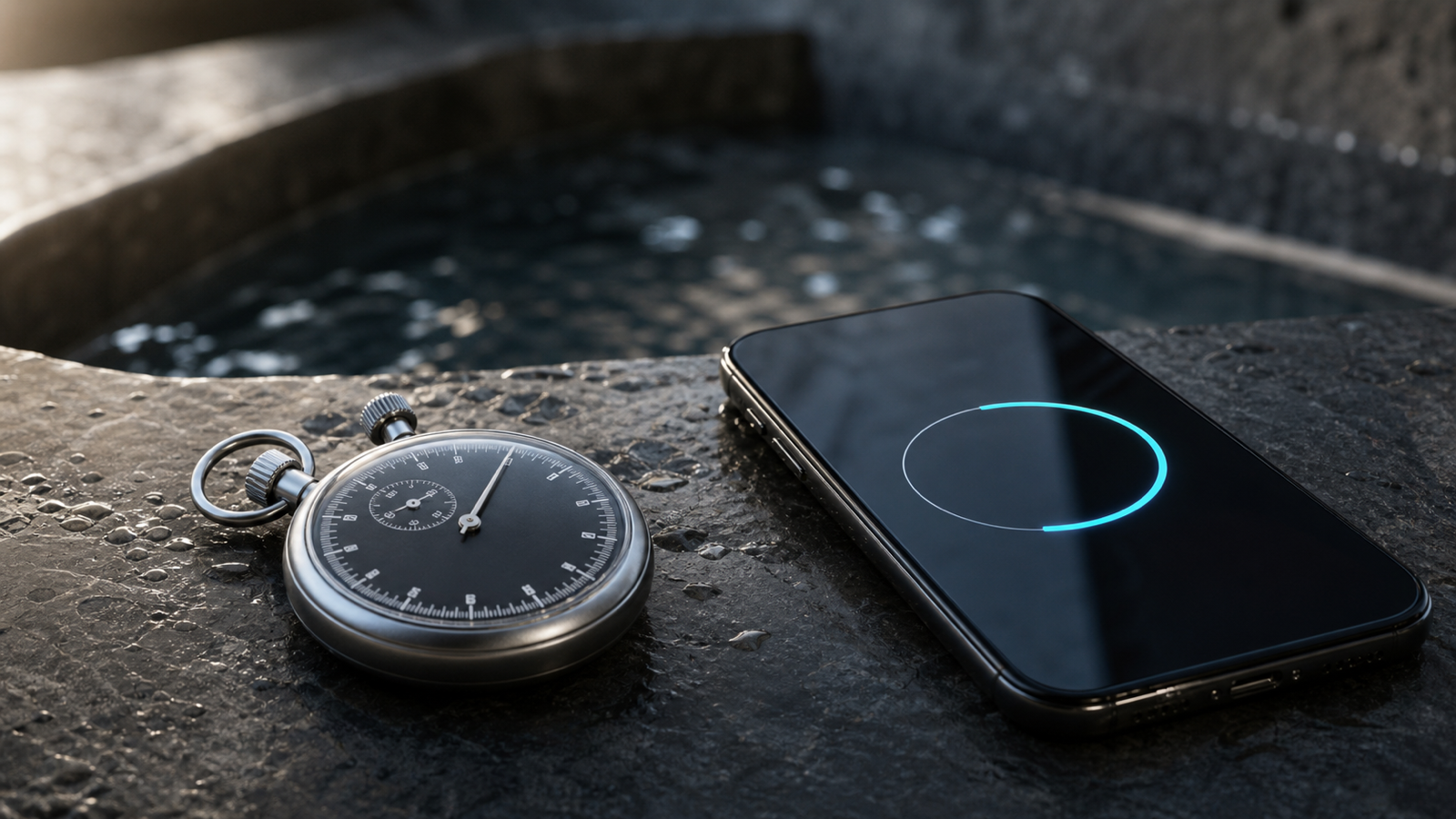
That is the practical difference. If all you care about is elapsed time, a stopwatch can do the narrow job. If you want to save the duration, water temperature, notes, history, stats, and consistency over time, a focused cold plunge timer and log is the better tool.
This is not about making the routine complicated. The best tracking system is quiet and repeatable. Start the timer, save the useful details, and move on.
When a stopwatch is enough
A stopwatch is enough when the session is a one-off and you do not care about the record afterward.
That might be fine if you are trying a cold plunge once, using a gym plunge casually, or already keeping a separate log somewhere else. In that case, the stopwatch answers the only question you are asking in the moment: how long was I in the water?
The limitation is that the answer disappears unless you write it down, screenshot it, or remember it. A stopwatch measures the moment. It does not build the history.
For cold exposure, that history becomes useful quickly. The difference between a controlled two-minute session and a rushed two-minute session may not show up in the timer result. The difference between two minutes at warmer water and two minutes at colder water will not show up either. Without a log, the number has less context than it appears to have.
Where a stopwatch falls short
The stopwatch problem is not timing. It is everything around timing.
Cold plunge sessions usually need at least a few pieces of context:
- how long the session lasted
- what the water temperature was
- when the session happened
- whether anything about the setup or routine was different
- whether you are becoming more consistent over time
A stopwatch does not save those details. A notes app can, but then the workflow becomes split: one tool for timing, another for writing, another for reviewing history. That friction is small once. It becomes annoying when you are trying to keep a routine.
The better setup is not a more complicated setup. It is a single place where timing and logging belong together.
Cold plunge timer vs stopwatch
| Need | Stopwatch | Cold plunge timer and log |
|---|---|---|
| Time the session | Yes | Yes |
| Save duration automatically | Usually no | Yes |
| Record water temperature | No | Yes |
| Add short notes | No | Yes |
| Review past sessions | No | Yes |
| See consistency over time | No | Yes |
| Keep the workflow focused | Limited | Yes |
The stopwatch is good at one job. A cold plunge timer is better when the timer result is only the start of the useful record.
That matters because progress in a cold water routine is not always a single longer duration. Sometimes progress is showing up consistently. Sometimes it is keeping the same duration at a colder temperature. Sometimes it is noticing that a shorter, calmer session works better than forcing a longer one.
You cannot see those patterns from isolated stopwatch results.
What a good cold plunge timer should track
A good cold plunge timer should stay minimal. It does not need to become a fitness dashboard or a medical tool.
The useful fields are simple:
| Field | Why it matters |
|---|---|
| Duration | The core timing record for each session. |
| Water temperature | Gives context to the duration. |
| Date and time | Turns separate sessions into a history. |
| Notes | Captures anything unusual without overthinking it. |
| Stats or progress | Helps you see consistency over time. |
Duration alone can be misleading. Three minutes at one temperature is not the same as three minutes at another temperature. A two-minute session after poor sleep may feel different from a two-minute session after a calm morning. A log does not need to explain everything, but it gives the timer result enough context to be useful.
Short notes are enough. Examples:
- after sauna
- morning session
- colder than usual
- first session after travel
- felt controlled
The point is not to write an essay after every plunge. The point is to preserve the detail that your future self would otherwise have to guess.
Why timing and logging work better together
Cold plunges are easy to time and surprisingly easy to forget accurately.
People remember the standout sessions: the first one, the coldest one, the uncomfortable one, the session that felt unusually good. Routine sessions blur together. That makes it harder to know whether you are actually becoming more consistent or simply remembering the most dramatic moments.
When the timer and log are connected, the routine becomes cleaner:
- start the timer
- finish the session
- save temperature and notes
- review history when needed
This is the workflow Cold Plunge Timer & Log is designed around: timer, logs, and stats in one focused iPhone app. The app direction is intentionally narrow. It is not trying to be a broad wellness platform. It is meant to help you time cold plunges, save each session, and see progress over time.
That is also why the app's privacy direction matters. A cold plunge log should not need an account, ads, or advertising tracking to be useful. The record should serve the routine.
Ice baths have the same timing problem
The same logic applies to ice baths.
An ice bath timer can measure how long you stayed in the water, but duration still needs temperature and context. Ice baths can vary a lot from session to session because the amount of ice, water volume, room temperature, and setup all affect the experience.
If you are using both ice baths and cold plunges, the tracking fields do not need to change much:
- duration
- water temperature
- setup type
- notes
- progress over time
The label can change. The record should stay simple.
What to choose
Use a stopwatch if you only need a single elapsed time and do not care about saving the result.
Use a cold plunge timer and log if you want a calmer record of the routine: duration, temperature, notes, history, stats, and consistency.
For a health-conscious adult who already takes the routine seriously, the second option is usually the more useful one. Not because the act of tracking is special, but because the right details make the routine easier to understand without relying on memory.
The best system is the one you will actually use after the session is over.
Safety note
A timer is not safety gear. A log is not medical advice.
Cold exposure is not appropriate for everyone, and cold water can stress breathing and the cardiovascular system, especially with sudden immersion, very cold temperatures, longer exposure, open water, existing medical conditions, or high cumulative stress.
This article is not medical advice, diagnosis, treatment, personalized safety guidance, or emergency support. If you are unsure whether cold exposure is appropriate for you, speak with a qualified health professional.
Do not rely on an app, timer, article, or tracking system during an emergency.
FAQ
Is a stopwatch enough for a cold plunge?
A stopwatch is enough if you only want to measure one session. It is less useful if you want to save duration, water temperature, notes, history, and progress over time.
What should a cold plunge timer track?
A useful cold plunge timer should track duration, water temperature, date, short notes, and progress or consistency over time.
Why not just use a notes app?
A notes app can work, but it separates timing from logging. A focused cold plunge timer keeps the timer result and session details in one place.
Can the same timer work for ice baths?
Yes. Ice baths need the same basic tracking fields: duration, water temperature, notes, and progress over time.
Does tracking make cold plunges safer?
Tracking can help you keep a clearer record, but it does not make cold exposure safe for everyone. Use cold exposure carefully and seek professional guidance if you are unsure.