
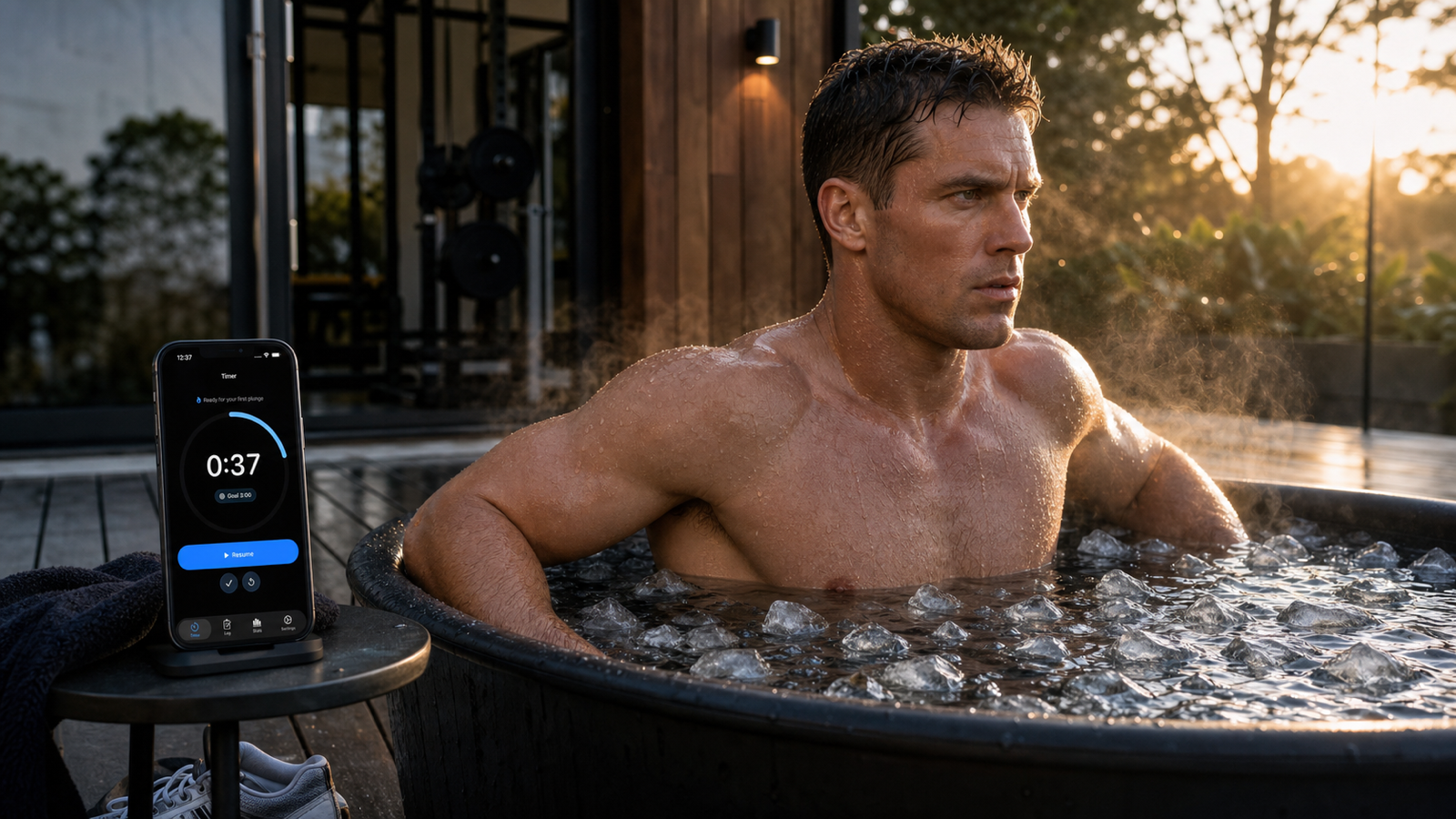
That does not mean every benefit is proven for every person. Cold water immersion research is mixed, and study protocols vary by water temperature, duration, immersion depth, timing, training status, and outcome measured. A cold plunge after a hard workout is different from a short cold shower, a winter swim, or a daily plunge done for routine.
This guide looks at five practical reasons people use cold plunges, where the evidence is stronger or weaker, and what to track if you want to understand your own pattern over time.
Why "cold plunge benefits" needs careful wording
Cold plunges are popular because they feel direct. The water is cold, the response is immediate, and the experience is easy to remember. That makes it tempting to turn the feeling into a broad health claim.
The research picture is more careful. A 2025 systematic review on cold-water immersion and wellbeing found that the evidence behind many health claims is still developing. Some findings suggest possible changes in stress, sleep, quality of life, inflammation, or soreness, but the studies are not all measuring the same thing. Many are small, short term, focused on specific populations, or built around different protocols.
So the practical question is not "are cold plunges good?" A better question is: what reason are you using cold water immersion for, and are you tracking enough context to know whether it is useful for you?
1. Post-workout recovery and soreness management
One of the most common reasons people use cold plunges is workout recovery. Cold water immersion has been studied for muscle soreness and perceived recovery after strenuous exercise. Some reviews suggest it may help people feel less sore after hard sessions, especially when the goal is short-term recovery.
That benefit should be kept in context. Feeling less sore is useful, but it is not the same as proving better long-term training adaptation. If your priority is strength or muscle growth, using cold water immediately after every lifting session deserves more caution. Some research suggests frequent post-exercise cold water immersion may interfere with parts of the adaptation process after resistance training.
The practical takeaway is simple: cold plunges may be useful after some hard sessions, competitions, or back-to-back training days, but they should not automatically follow every workout. For more detail, see Cold Plunge After Workout: What to Know Before You Make It a Habit.
2. A short reset ritual
Some people use cold water immersion because it creates a clear before-and-after moment in the day. The cold forces attention. It can feel like a reset after sleep, work, training, sauna, or a long day.
This is one of the most honest reasons to cold plunge, as long as it is not overstated. A reset ritual is not the same as a medical treatment. Cold exposure can feel energizing or clarifying for some people, but that does not mean it treats anxiety, depression, burnout, or any other condition.
If you use cold plunges this way, track the subjective pattern rather than making a broad claim. Note whether the session felt controlled, whether you felt calmer or more alert afterward, and whether that effect lasted. Short notes are more useful than memory, especially once the habit becomes routine.
3. Heat-to-cold contrast after sauna or exercise
Cold plunges are often paired with sauna, hot tubs, or exercise. The contrast can feel satisfying: heat, cold, rewarming, then a settled feeling afterward. Many people enjoy this rhythm because it gives structure to a recovery session.
The important point is that contrast does not remove the basic safety variables. Cold water still affects breathing, heart rate, blood pressure, coordination, and heat loss. Coming from heat into cold can also make the cold feel sharper than expected.
If you use heat-to-cold contrast, keep the first cold exposure conservative and track the basics: water temperature, duration, how hot you were before entering, and how you felt after rewarming. The goal is not to prove toughness. The goal is to keep the routine repeatable and controlled.
4. Tracking cold tolerance over time
Another practical reason people use cold plunges is to understand whether they are becoming more comfortable with a specific level of cold exposure.
This is where tracking matters. Without a log, a cold plunge habit can become vague. You may remember the dramatic sessions and forget the ordinary ones. You may think you are improving when the water was actually warmer, the session shorter, or the setup easier.
A useful cold plunge tracker records at least:
- duration
- water temperature
- date and time
- short notes
- how controlled the session felt
- consistency or streaks when relevant
Temperature and time should be read together. Two minutes in colder water is not the same as two minutes in milder cold water. For broader tracking guidance, see How to Track Cold Plunge Sessions, What Temperature Should a Cold Plunge Be?, and Cold Plunge Temperature and Time: A Practical Beginner Guide.
5. Building consistency around a short habit
Cold plunges are also appealing because the habit is short. A session can be simple: set a timer, enter, breathe, exit, save the log. For some people, that small structure makes the routine easier to repeat.
Consistency can be useful, but it should not become pressure. A streak is not a safety plan. If you are sick, unusually stressed, poorly recovered, unsure about a symptom, or dealing with a medical condition, skipping a session can be the better decision.
The healthiest use of a streak is as a record, not a command. Track consistency to understand your routine, not to force a session that does not make sense that day. For more on this, see Cold Plunge Streak Tracker: Why Consistency Matters.
What to track if you care about benefits
If you are cold plunging for recovery, routine, or consistency, the most useful log is simple:
- water temperature
- duration
- time of day
- whether it followed a workout, sauna, or rest day
- short notes about soreness, energy, stress, or sleep
- whether the session felt controlled
Do not try to track everything. A cold plunge log should make the pattern easier to understand, not turn the habit into homework.
Common mistakes
The first mistake is treating every cold plunge benefit as proven. Some claims have research support in specific contexts. Others are still uncertain, overstated, or based mostly on subjective experience.
The second mistake is chasing colder water as if colder automatically means better. Colder water usually makes the same duration more intense, and it can increase the importance of safe entry, breathing control, and safe exit.
The third mistake is using cold plunges as a replacement for basics. Sleep, training load, nutrition, hydration, and stress management still matter more than a short cold exposure habit.
The fourth mistake is not tracking temperature. If you only track duration, you may miss the biggest variable in the session.
Safety note
Cold exposure is not appropriate for everyone. This article is educational only. It is not medical advice, diagnosis, treatment, personalized safety guidance, or emergency support.
Cold water can stress breathing and the cardiovascular system, especially with sudden immersion, very cold temperatures, longer exposure, open water, existing medical conditions, or high cumulative stress. If you are unsure whether cold exposure is appropriate for you, speak with a qualified health professional.
Do not rely on an article, app, timer, or tracking system during an emergency.
FAQ
What are the main cold plunge benefits?
People commonly use cold plunges for post-workout recovery, a short reset ritual, heat-to-cold contrast, tracking cold tolerance, and building consistency. The evidence varies by benefit, protocol, and person.
Are cold plunge benefits proven?
Some cold-water immersion effects have been studied, especially around soreness and recovery, but broad claims are often overstated. Benefits depend on temperature, duration, timing, health context, and what outcome is being measured.
Do cold plunges help workout recovery?
Cold water immersion may help some people feel less sore after strenuous exercise. It may be less appropriate as an automatic habit after every strength session if muscle growth or strength adaptation is the main goal.
Do cold plunges improve mental health?
Cold plunges may feel energizing or provide a short reset for some people, but they should not be treated as a mental health treatment. If you are dealing with anxiety, depression, or another condition, speak with a qualified professional.
What should I track in a cold plunge log?
Track water temperature, duration, date, time of day, context such as workout or sauna, short notes, and whether the session felt controlled. Those details make the pattern more useful than time alone.
Are cold plunges safe for everyone?
No. Cold exposure is not appropriate for everyone and can stress breathing and the cardiovascular system. People with medical conditions or uncertainty about cold exposure should speak with a qualified health professional.
References
- Cain T, Brinsley J, Bennett H, Nelson M, Maher C, Singh B. Effects of cold-water immersion on health and wellbeing: A systematic review and meta-analysis. PLOS ONE. 2025.
- Moore E, Fuller JT, Bellenger CR, Saunders S, Halson SL, Nelson MJ, et al. Impact of cold-water immersion compared with passive recovery following a single bout of strenuous exercise. Sports Medicine. 2022.
- Bleakley C, McDonough S, Gardner E, Baxter GD, Hopkins JT, Davison GW. Cold-water immersion for preventing and treating muscle soreness after exercise. Cochrane Database of Systematic Reviews. 2012.
- Roberts LA, Raastad T, Markworth JF, Figueiredo VC, Egner IM, Shield A, et al. Post-exercise cold water immersion attenuates acute anabolic signalling and long-term adaptations in muscle to strength training. The Journal of Physiology. 2015.
- Buijze GA, Sierevelt IN, van der Heijden BCJM, Dijkgraaf MG, Frings-Dresen MHW. The Effect of Cold Showering on Health and Work: A Randomized Controlled Trial. PLOS ONE. 2016.
- Tipton M, Bradford C. Moving in extreme environments: open water swimming in cold and warm water. Extreme Physiology & Medicine. 2014.
- Mayo Clinic Press. Cold Plunge Benefits: The Science Behind Ice Baths for Recovery.
- American Heart Association. You're not a polar bear: The plunge into cold water comes with risks.