
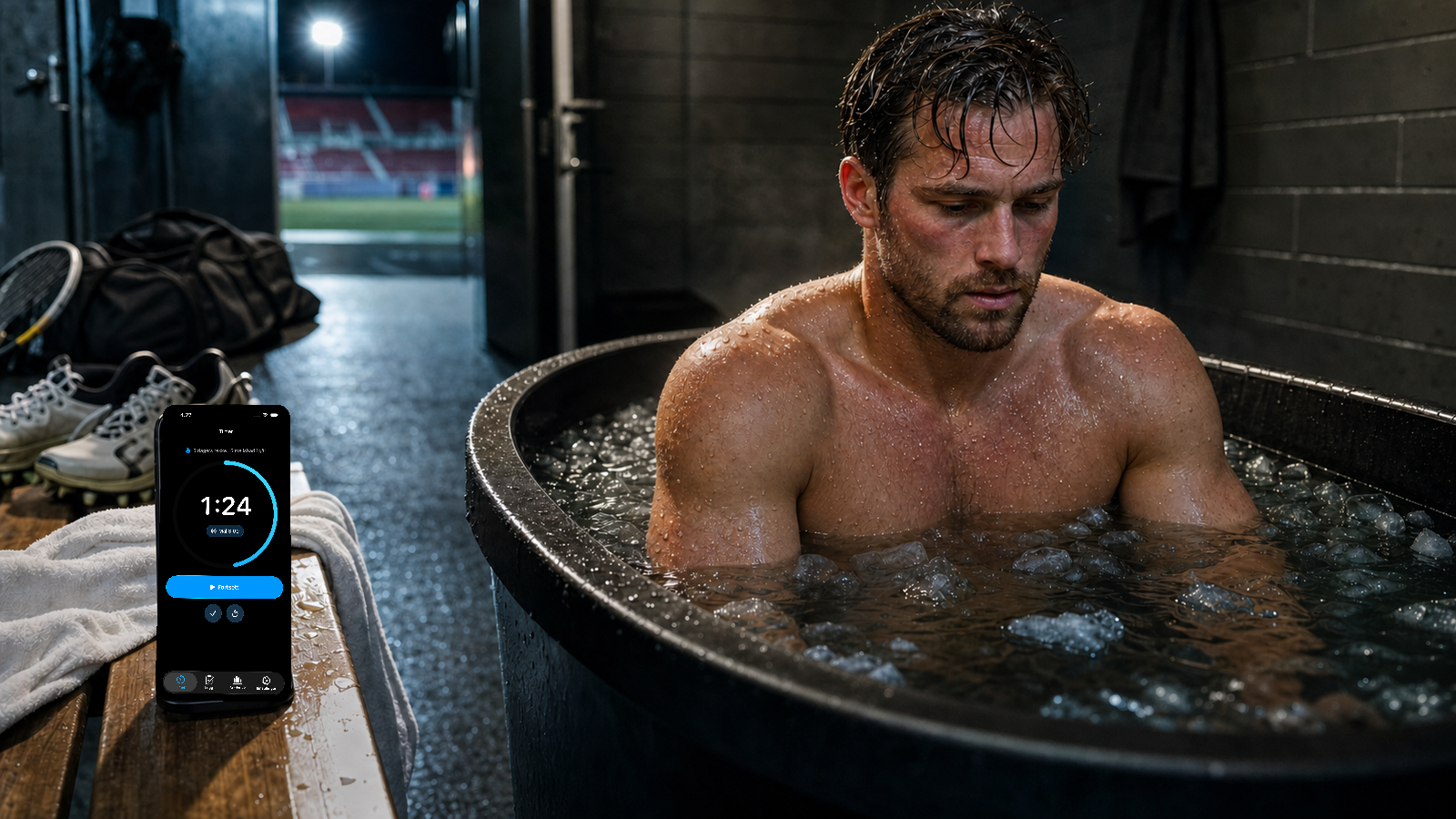
A cold plunge for athletes can be useful after some matches, tournaments, or hard training blocks, but it should not be treated as a guaranteed recovery shortcut. The most practical use is short-term recovery support when soreness, perceived fatigue, or a quick turnaround matters.
The better question is not "should every athlete cold plunge after every game?" A better question is: what recovery problem are you trying to solve today, and are you tracking enough detail to know whether cold water is helping your routine?
This guide explains where cold plunges may fit after sport, where the evidence needs caution, and what athletes should track after a post-match cold plunge.
Why post-match recovery is different from a normal workout
A match is not the same as a controlled gym session. In sport, the load is often unpredictable. You may sprint, cut, jump, collide, travel, compete in heat, dehydrate, or play more minutes than expected. Different sports create different recovery demands.
That context matters because cold water immersion is not one thing. Research protocols vary by temperature, immersion depth, duration, timing after exercise, sport type, and outcome measured. A finding about perceived fatigue after team sport does not become a universal rule for every athlete.
For athletes, the best cold plunge routine is specific. It should consider the sport, match load, next training day, and reason for using cold water.
What cold plunges may help with after sport
Cold water immersion has been studied as a recovery strategy after strenuous exercise and team sport. A team-sport systematic review and meta-analysis found some evidence that cold water immersion may support certain neuromuscular and subjective fatigue outcomes at specific time points. Other outcomes were less consistent.
That distinction matters. "May help with recovery" does not mean "will improve every performance measure." It usually means cold water immersion may help some athletes feel less fatigued, manage soreness, or prepare for another session under certain conditions.
This is most relevant when recovery time is limited:
- a tournament weekend
- two matches close together
- repeated sprint or collision sports
- a hard practice block where soreness is interfering with readiness
If the next important session is soon, short-term recovery may be the priority. In that case, a conservative cold plunge may be worth testing.
What cold plunges do not replace
A cold plunge does not replace the basics of athlete recovery. Sleep, hydration, food, warm-down habits, training load management, and injury care still matter more than a cold tub.
Cold water also does not treat injuries. If an athlete has a suspected strain, concussion, dizziness, unusual pain, or another medical concern, the answer is appropriate medical support.
It is also worth separating soreness from readiness. Feeling less sore can be useful, but it does not always mean the body is fully recovered.
Match type and training goal matter
Different sports create different reasons to use cold water. After a long endurance event, the goal may be reducing perceived soreness and starting a structured recovery process. After a collision or repeated-sprint sport, the goal may be managing whole-body fatigue before another session.
Strength and muscle-building goals need more caution. Research on resistance training suggests that frequent immediate post-exercise cold water immersion may interfere with some adaptation signals and longer-term strength or muscle gains in the studied context. That does not mean cold plunges "ruin gains." It means cold water should not automatically follow every strength session.
For match recovery, the tradeoff may be different. If the competition calendar is dense, short-term readiness may matter more than maximizing adaptation from one session.
Practical temperature and time guidance
Athletes do not need to chase the coldest possible session. Colder water usually means the same duration becomes more intense.
A practical beginner-friendly framework:
| Water temperature | Intensity | Practical post-match approach |
|---|---|---|
| 50-59°F / 10-15°C | Moderate cold | Often a more realistic starting range for controlled post-match recovery routines. |
| 45-49°F / 7-9°C | More intense | Use shorter exposure and more caution, especially after a draining match. |
| Below 45°F / 7°C | Advanced | Not a casual recovery default. Extra caution matters. |
The right session depends on experience, match load, environment, and the next training demand. A short, controlled session in moderately cold water is usually more useful than forcing a long session in water that is too cold.
For more detail, see Cold Plunge Temperature and Time: A Practical Beginner Guide and How Long Should You Stay in a Cold Plunge?
What athletes should track after a cold plunge
If an athlete uses cold water after matches, tracking turns the routine into a useful record.
Useful fields include:
- sport or match type
- perceived match intensity
- time between match and plunge
- water temperature
- cold plunge duration
- soreness notes
- fatigue notes
- sleep quality that night
- readiness the next day
The point is not to build a medical record. The point is to notice patterns. If colder sessions leave you drained, that matters. If moderate sessions after tournaments help you feel more ready the next day, that matters too.
For a general tracking structure, see How to Track Cold Plunge Sessions.
A simple post-match checklist
Before using cold water after sport, ask:
- Was this match unusually hard?
- Do I need short-term recovery for another session soon?
- Am I steady and safe to enter cold water?
- Is the water temperature known?
- Do I have a clear stop point?
- Am I tracking enough to compare this session later?
If several answers are unclear, the smarter choice may be to skip the plunge or make the session shorter and warmer.
Common mistakes
The first mistake is treating a cold plunge as proof of a serious recovery routine. A cold tub can be useful, but it is only one recovery tool.
The second mistake is ignoring match context. A light skills session and a high-minute competitive match do not require the same recovery plan.
The third mistake is making cold water too cold too soon. Athletes may already have fatigue, dehydration, heat exposure, travel, or stress after competition.
The fourth mistake is tracking only time. Duration without water temperature, match context, and next-day notes gives an incomplete picture.
Safety note
Cold exposure is not appropriate for everyone. This article is educational only. It is not medical advice, diagnosis, treatment, personalized safety guidance, or emergency support.
Cold water can stress breathing and the cardiovascular system, especially with sudden immersion, very cold temperatures, longer exposure, open water, existing medical conditions, dehydration, heat stress, or high cumulative stress after sport. If you are unsure whether cold exposure is appropriate for you, speak with a qualified health professional.
Do not rely on an article, app, timer, or tracking system during an emergency.
FAQ
Is a cold plunge good for athletes after a match?
It can be useful in some post-match recovery situations, especially when soreness, perceived fatigue, or short turnaround time matters. It is not necessary after every match.
Does an ice bath help post-match recovery?
Cold water immersion may help some recovery measures after team sport and strenuous exercise, but results vary by protocol, sport, and outcome.
How long should athletes stay in a cold plunge?
There is no single best time for every athlete. Duration should be paired with water temperature, experience level, match load, and safety context.
What temperature should an athlete use after a game?
Many athletes start with a controlled, moderate cold range rather than extreme cold. Around 50-59°F / 10-15°C is often more practical than very cold water.
Should athletes cold plunge after strength training?
Use more caution if strength or muscle growth is the main goal. Some research suggests frequent immediate cold water immersion after resistance training may affect parts of the adaptation process.
What should athletes track after a cold plunge?
Track water temperature, duration, sport type, match intensity, timing after the match, soreness, fatigue, sleep, and next-day readiness.
References
- Higgins TR, Greene DA, Baker MK. Effects of Cold Water Immersion and Contrast Water Therapy for Recovery From Team Sport: A Systematic Review and Meta-analysis. Journal of Strength and Conditioning Research. 2017.
- Moore E, Fuller JT, Bellenger CR, Saunders S, Halson SL, Nelson MJ, et al. Impact of cold-water immersion compared with passive recovery following a single bout of strenuous exercise. Sports Medicine. 2022.
- Bleakley C, McDonough S, Gardner E, Baxter GD, Hopkins JT, Davison GW. Cold-water immersion for preventing and treating muscle soreness after exercise. Cochrane Database of Systematic Reviews. 2012.
- Roberts LA, Raastad T, Markworth JF, Figueiredo VC, Egner IM, Shield A, et al. Post-exercise cold water immersion attenuates acute anabolic signalling and long-term adaptations in muscle to strength training. The Journal of Physiology. 2015.
- Tipton M, Bradford C. Moving in extreme environments: open water swimming in cold and warm water. Extreme Physiology & Medicine. 2014.