
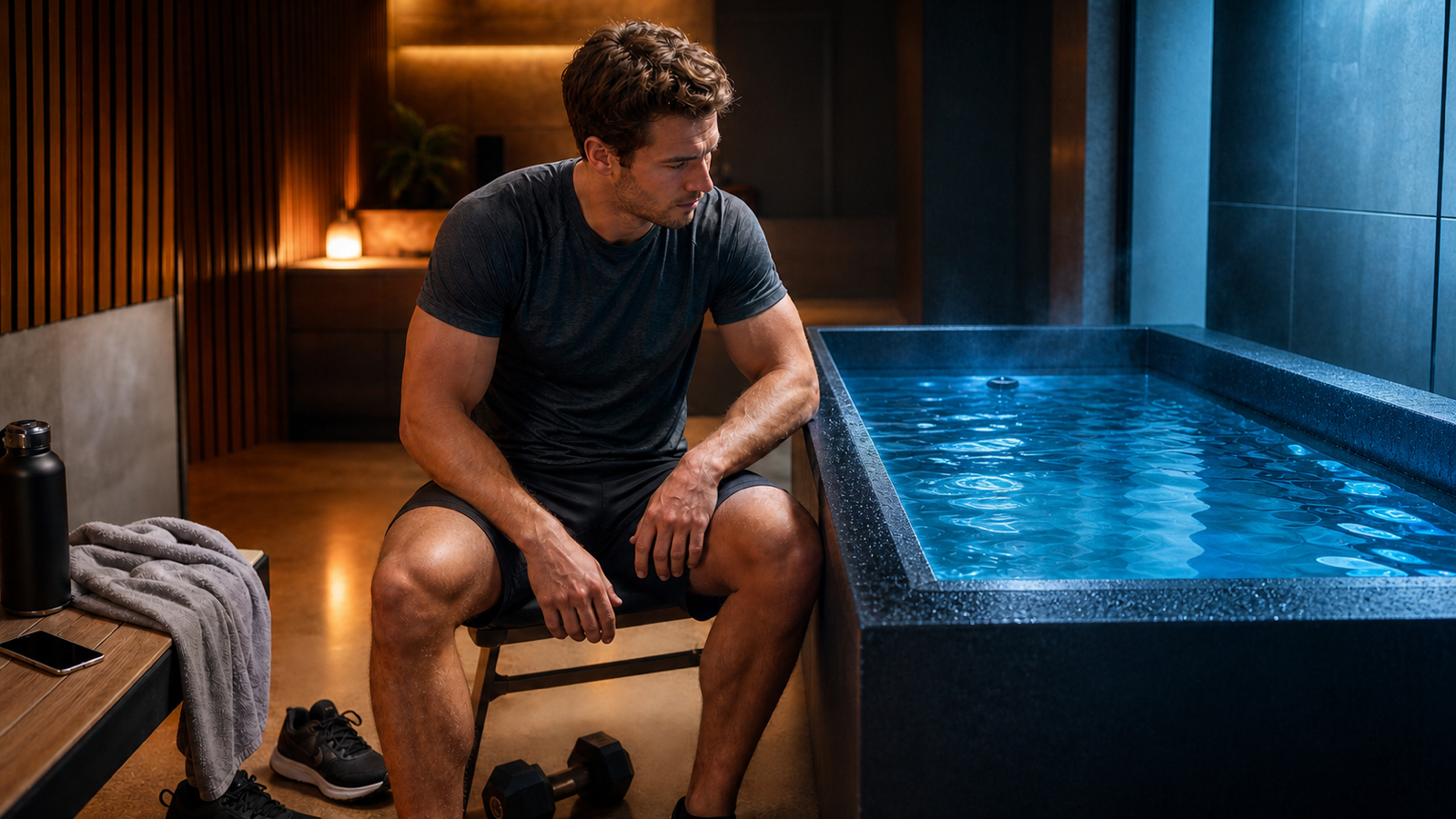
The practical answer depends on the workout, your training goal, timing, water temperature, duration, and how your body responds afterward.
If your goal is short-term recovery after a hard session, cold water immersion may help some people feel less sore. If your goal is strength or muscle growth, using cold water immediately after every lifting session deserves more caution because some research suggests it may interfere with parts of the adaptation process.
The better question is not "is a cold plunge after workout good or bad?" A better question is: what job are you asking the cold plunge to do after this specific workout?
Why workout context matters
Not every workout creates the same recovery problem. A heavy strength session, a long run, a high-intensity interval workout, a recreational sport day, and a light mobility session are different stressors. Treating them all the same makes the habit less useful.
Cold water immersion research also varies by protocol. Studies differ in water temperature, immersion time, timing after exercise, participant training status, and the outcome being measured. A result about muscle soreness after one type of session does not automatically become a rule for every athlete, beginner, or health-conscious adult.
That is why a cold plunge after exercise works best as a decision, not a reflex.
Recovery versus adaptation
Recovery and adaptation are related, but they are not the same thing.
Recovery is about how you feel and perform after a workout: soreness, fatigue, readiness, sleep, or simply feeling settled after training.
Adaptation is about what your body builds from the training stress over time. For strength training, that can include muscle growth, strength gains, and the signaling that supports those changes.
Cold water may reduce some discomfort after hard exercise. That can be useful when you need to feel fresher soon. But if the training stress is the signal you want your body to adapt to, immediately dampening that signal every time may not always align with the goal.
This does not mean cold plunges "ruin gains." That is too blunt. It means the timing and frequency of post-workout cold exposure should match your training priority.
Strength training deserves extra caution
If you are lifting primarily to build strength or muscle, be careful about making an immediate cold plunge after every workout your default habit.
Research by Roberts and colleagues found that post-exercise cold water immersion attenuated acute anabolic signaling and long-term adaptations in muscle to strength training in their study context. That finding should not be turned into panic, but it is relevant. If the main goal is muscle growth or strength adaptation, routine immediate cold water immersion after lifting may not be the best fit.
The practical approach is simple:
- If soreness management is the priority, a post-workout cold plunge may be worth testing.
- If strength or hypertrophy adaptation is the priority, consider separating cold plunges from key lifting sessions or using them less frequently.
- If you still cold plunge after lifting, track whether performance, soreness, sleep, and next-session readiness actually improve.
For many people, the answer may be occasional use rather than an automatic ritual.
Endurance and hard-session recovery
Cold water immersion is often discussed in recovery contexts, especially after strenuous exercise. Reviews and trials have looked at outcomes such as muscle soreness, perceived recovery, and performance after hard sessions.
That does not mean every endurance workout needs a cold plunge. A light run or easy bike session may not require much recovery intervention. But after unusually hard training, competition, or repeated sessions close together, some people may use cold water as part of a broader recovery routine.
The key is to avoid confusing "I feel fresher right now" with "this is always improving my training." Both can be useful, but they are different claims.
If you use cold plunges after hard workouts, look for patterns over several sessions instead of judging one day. Do you sleep better or worse? Is next-day soreness lower? Are you more ready for the next workout?
Timing, temperature, and duration still matter
Post-workout timing does not replace the basics. Water temperature and duration still shape the session.
A short cold plunge in moderately cold water is not the same as a long session in colder water. If you are fatigued, dehydrated, overheated, underfed, or mentally drained after training, the same cold exposure may feel different than it does on a normal day.
If you are unsure about duration, use a conservative approach and adjust slowly. Do not change temperature, duration, and frequency all at once. For timing basics, see how long should you stay in a cold plunge. For water temperature context, see what temperature should a cold plunge be.
The useful habit is not chasing the coldest or longest session. The useful habit is knowing what you did and how you responded.
What to track after a workout cold plunge
If you make cold plunging part of your workout routine, track enough context to make the pattern visible.
Useful fields include:
- workout type
- workout goal
- time between workout and plunge
- water temperature
- cold plunge duration
- how controlled the session felt
- soreness or fatigue notes
- next-day readiness
The workout goal matters because the same plunge may be a good fit after one session and a questionable fit after another.
For a broader logging framework, read how to track cold plunge sessions.
Common mistakes
The first mistake is treating a cold plunge after workout as automatically better. It is a tool, not proof that the workout was serious.
The second mistake is ignoring the training goal. If you are in a strength or muscle-building phase, post-workout cold exposure should be used more deliberately.
The third mistake is copying someone else's protocol. Their water temperature, training age, session type, health context, and reason for cold plunging may be different from yours.
The fourth mistake is failing to log anything. Without time, temperature, workout context, and notes, it is hard to know whether the habit is helping.
A practical way to decide
Before you cold plunge after a workout, ask three questions:
- What was the workout for?
- What do I want from recovery today?
- Will this cold plunge support that goal, or could it interfere with it?
If you trained hard and need to feel ready again soon, a cold plunge may be reasonable to test. If you lifted for strength or muscle growth and do not need rapid short-term recovery, you may choose to wait, skip it, or cold plunge on a different day.
That kind of decision is more useful than a permanent rule.
Safety note
Cold exposure is not appropriate for everyone. This article is educational only. It is not medical advice, diagnosis, treatment, personalized safety guidance, or emergency support.
Cold water can stress breathing and the cardiovascular system, especially with sudden immersion, very cold temperatures, longer exposure, existing medical conditions, open water, or high cumulative stress after exercise. If you are unsure whether cold exposure is appropriate for you, speak with a qualified health professional.
Do not rely on an article, app, timer, or tracking system during an emergency.
FAQ
Is a cold plunge after workout good?
It can be useful in some recovery contexts, especially when soreness or short-term readiness matters. It is not automatically best after every workout.
Should I cold plunge after lifting weights?
Use more caution after strength training, especially if your goal is muscle growth or strength adaptation. Some research suggests routine immediate cold water immersion may interfere with parts of the adaptation process.
When should I cold plunge after a workout?
There is no single best time for everyone. Timing should depend on the workout, your training goal, water temperature, duration, and how you respond. If adaptation is the priority, you may choose to separate cold plunges from key strength sessions.
Is an ice bath after workout the same idea?
For tracking purposes, yes. Whether you use an ice bath or a dedicated cold plunge, the basics are similar: duration, water temperature, timing after exercise, notes, and how you feel afterward.
What should I track after a post-workout cold plunge?
Track workout type, workout goal, time between workout and plunge, water temperature, duration, notes, and next-day readiness. Those details make the pattern more useful than time alone.
Is this medical advice?
No. This article is educational only and is not medical advice. If you have a medical condition or are unsure whether cold exposure is appropriate for you, speak with a qualified health professional.
References
- Moore E, Fuller JT, Bellenger CR, Saunders S, Halson SL, Nelson MJ, et al. Impact of cold-water immersion compared with passive recovery following a single bout of strenuous exercise. Sports Medicine. 2022.
- Bleakley C, McDonough S, Gardner E, Baxter GD, Hopkins JT, Davison GW. Cold-water immersion for preventing and treating muscle soreness after exercise. Cochrane Database of Systematic Reviews. 2012.
- Machado AF, Ferreira PH, Micheletti JK, de Almeida AC, Lemes IR, Vanderlei FM, et al. Can water temperature and immersion time influence the effect of cold water immersion on muscle soreness? Sports Medicine. 2016.
- Roberts LA, Raastad T, Markworth JF, Figueiredo VC, Egner IM, Shield A, et al. Post-exercise cold water immersion attenuates acute anabolic signalling and long-term adaptations in muscle to strength training. The Journal of Physiology. 2015.
- Cain T, Brinsley J, Bennett H, Nelson M, Maher C, Singh B. Effects of cold-water immersion on health and wellbeing: A systematic review and meta-analysis. PLOS ONE. 2025.
- Tipton M, Bradford C. Moving in extreme environments: open water swimming in cold and warm water. Extreme Physiology & Medicine. 2014.