
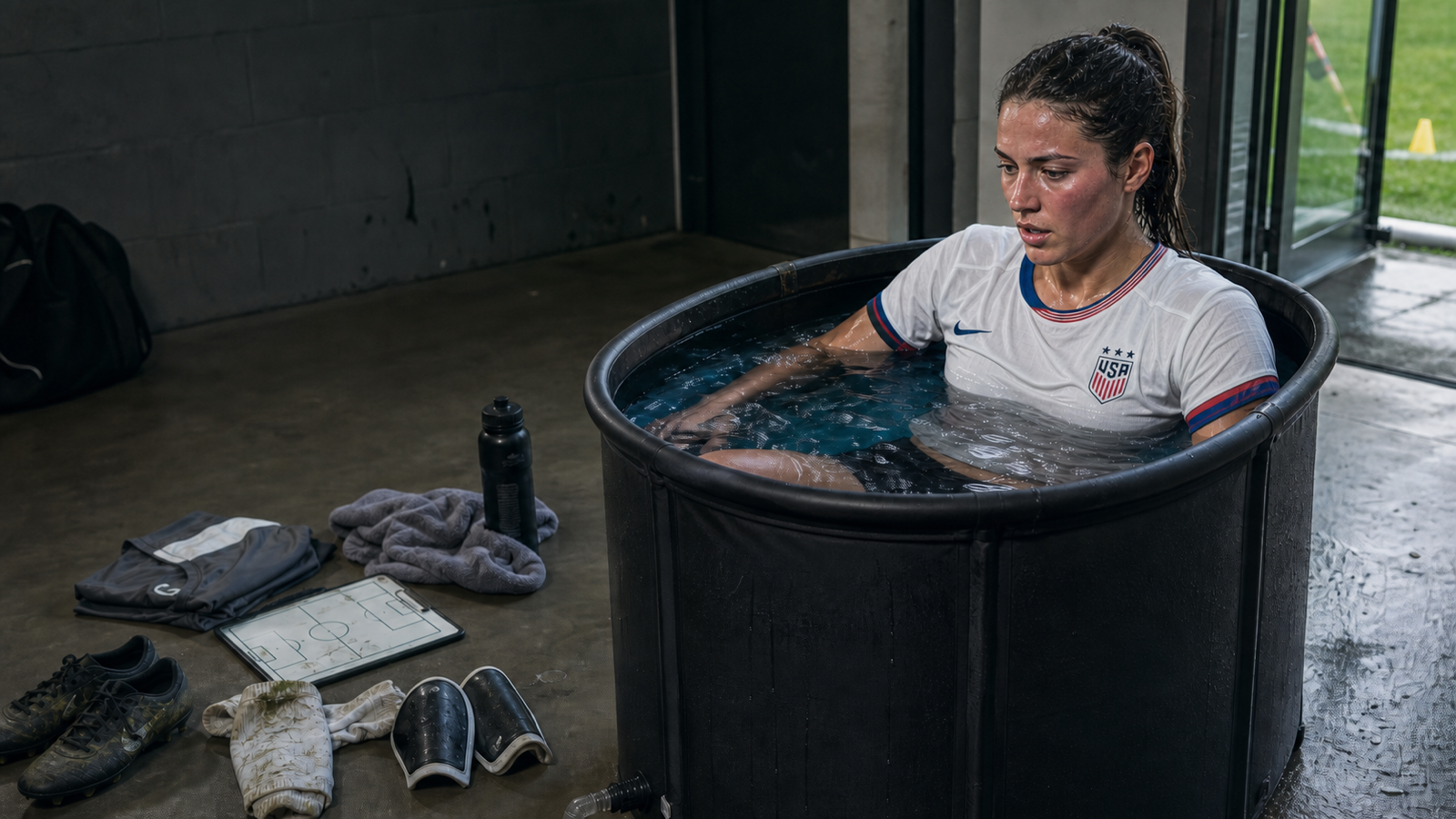
A cold plunge between games may fit an athlete's recovery plan when the next competition is close and short-term readiness matters. It is not a guaranteed performance boost, and it should not replace sleep, hydration, food, injury assessment, or sensible workload management.
The useful question is not simply, "Does cold water work?" A better question is: what needs to recover before the next game, how much time is available, and does cold exposure fit the athlete's training goal and current condition?
This guide explains what research supports, how tournament schedules change the decision, why strength-focused athletes may use more caution, and what to track so each session can be evaluated in context.
Why between-game recovery is a distinct problem
A tournament can compress several demands into one day or weekend. An athlete may combine repeated sprints, changes of direction, collisions, heat, travel, interrupted meals, and limited sleep. The recovery window may be measured in hours instead of days.
That makes short-term readiness more important than it would be after an ordinary practice. It also makes recovery more complicated. Soreness, fatigue, dehydration, injury, and reduced performance are not interchangeable problems.
Cold-water immersion research reflects that complexity. Studies use different sports, temperatures, durations, immersion depths, and outcome measures. A result about soreness or jump performance does not prove that every athlete will play better in the next game.
What the evidence supports, and what it does not
Research suggests cold-water immersion can help some recovery outcomes after strenuous exercise or team sport, but the effects are not uniform.
A 2026 systematic review and meta-analysis in trained soccer players reported improvements in some measures of strength recovery, jump performance, muscle-damage markers, and soreness. Sprint performance was not improved, and the authors emphasized uncertainty because prediction intervals included a possible null effect.
A broader 2022 systematic review also found mixed results across athletic performance, athlete perception, and creatine kinase after strenuous exercise. That is a useful reality check: a cold plunge may influence how an athlete feels or recovers on one measure without restoring every aspect of performance.
The practical conclusion is modest. Cold water may be worth testing when soreness or short turnaround time matters. It should not be presented as proof that an athlete is fully recovered or ready to compete.
Start with the turnaround time
The time before the next game changes the recovery decision.
| Competition schedule | Main consideration | Practical interpretation |
|---|---|---|
| Another game the same day | Immediate fatigue, hydration, fueling, and safe transition | Cold water is only one optional tool. Do not let it delay basic recovery or hide symptoms that need attention. |
| Another game the next day | Sleep, soreness, travel, and next-morning readiness | A controlled session may be easier to evaluate because the athlete can record evening and morning notes. |
| Two or more days available | Training adaptation and the full recovery process | The urgency is lower. Cold water may be less important than sleep, nutrition, mobility, and the planned training load. |
This table is not a protocol. It is a way to identify the actual problem before reaching for the tub.
Match recovery and training adaptation are different goals
An athlete may use cold water for short-term recovery after competition while avoiding it after every strength session. Those choices are not contradictory.
Meta-analyses of regular cold-water immersion after resistance training suggest it may attenuate some strength adaptations, although findings differ by immersion method and the available studies have limitations. This does not mean one post-match plunge will erase training gains. It means routine timing should match the goal.
If the priority is being ready for another game soon, short-term recovery may carry more weight. If the priority is building strength or muscle over a training block, automatically plunging immediately after every resistance session deserves more caution.
For a broader discussion, see Cold Plunge for Athletes: A Practical Post-Match Recovery Guide and Cold Plunge After Workout: What to Know Before You Make It a Habit.
Temperature and duration belong together
Athletes do not need extreme cold to create a demanding session. As water gets colder, the same duration generally feels more intense and places more stress on breathing and comfort.
A moderate range around 50-59 F / 10-15 C is often easier to control than colder water. Temperatures around 45-49 F / 7-9 C feel more intense, while water below 45 F / 7 C should not be treated as a casual tournament default.
These ranges are context, not personalized instructions. Experience, immersion depth, environmental temperature, fatigue, health status, and the next competition all matter. A shorter, controlled session is more useful than chasing a dramatic temperature or duration.
For more context, read Cold Plunge Temperature and Time: A Practical Beginner Guide and How Long Should You Stay in a Cold Plunge?.
What to track between games
Tracking helps separate the cold plunge from the rest of the recovery day. Record enough context to compare sessions without turning the log into a medical chart.
Useful fields include:
- sport, event, or match
- minutes played or a simple match-load note
- time until the next game
- time between the game and cold plunge
- water temperature
- immersion duration
- how controlled the session felt
- soreness and fatigue notes
- sleep quality when the next game is the following day
- readiness before the next warm-up
Duration alone is not enough. A three-minute session at one temperature, after one type of game, cannot be compared cleanly with a three-minute session in colder water after a different workload.
The goal is to notice patterns. If a routine repeatedly leaves the athlete shivering, drained, or rushed before the next commitment, that is useful information. If a controlled session consistently fits well into a tournament routine, that is useful too.
A simple between-game decision framework
Before entering the water, ask:
- What am I trying to improve before the next game: soreness, comfort, or perceived fatigue?
- Have hydration, food, dry clothing, and injury checks already been handled?
- Am I alert, steady, and able to enter and exit safely?
- Do I know the water temperature and have a clear stop point?
- Will this session support the schedule, or create another stressful task?
If the answers are unclear, skipping the plunge can be the sensible recovery choice.
Common mistakes
The first mistake is treating reduced soreness as proof of complete recovery. An athlete can feel better without every performance measure returning to baseline.
The second is using the coldest water available because the tournament feels important. More intense does not automatically mean more useful.
The third is allowing the plunge to displace basics such as hydration, food, sleep, or medical assessment.
The fourth is applying the same routine after every game and training session. Competition recovery and long-term training adaptation may call for different choices.
The fifth is tracking only duration. Temperature, workload, timing, and next-game readiness provide the context that makes a log useful.
Safety note
Cold exposure is not appropriate for everyone. This article is educational only. It is not medical advice, diagnosis, treatment, personalized safety guidance, or emergency support.
Cold water can stress breathing and the cardiovascular system, especially with sudden immersion, very cold temperatures, longer exposure, open water, existing medical conditions, dehydration, heat stress, or high cumulative fatigue. An athlete who is dizzy, confused, injured, unusually short of breath, or otherwise unwell needs appropriate support, not a recovery challenge.
If you are unsure whether cold exposure is appropriate, speak with a qualified health professional. Do not rely on an article, app, timer, or tracking system during an emergency.
FAQ
Is a cold plunge useful between tournament games?
It may help some athletes manage soreness or perceived fatigue when games are close together. It does not guarantee better performance in the next game.
How soon after a game should an athlete cold plunge?
There is no universal timing rule. First prioritize injury checks, hydration, food, dry clothing, and a safe transition out of competition. The available recovery window and the athlete's condition matter.
Does a cold plunge restore sprint performance?
Not reliably. Research in team-sport and soccer settings reports mixed results, and a recent soccer meta-analysis did not find improved sprint recovery.
Should strength athletes use cold water between events?
The decision depends on the immediate competition goal and the broader training plan. Regular cold-water immersion immediately after resistance training may affect some strength adaptations, so routine use should be considered carefully.
What should athletes track between games?
Track match load, time until the next game, water temperature, immersion duration, timing after competition, soreness, fatigue, and readiness before the next warm-up.
Is this medical advice?
No. This is general educational information. Athletes with health concerns, injuries, or uncertainty about cold exposure should seek qualified professional guidance.
References
- Veen J, Bergh C, Cao Y, Randers MB, Krustrup P, Edholm P. The Impact of Cold-Water Immersion on Post-Match Recovery in Trained Soccer Players: A Systematic Review and Meta-Analysis. Scandinavian Journal of Medicine & Science in Sports. 2026.
- Moore E, Fuller JT, Bellenger CR, Saunders S, Halson SL, Nelson MJ, et al. Impact of Cold-Water Immersion Compared with Passive Recovery Following a Single Bout of Strenuous Exercise on Athletic Performance in Physically Active Participants. Sports Medicine. 2022.
- Higgins TR, Greene DA, Baker MK. Effects of Cold Water Immersion and Contrast Water Therapy for Recovery From Team Sport. Journal of Strength and Conditioning Research. 2017.
- Malta ES, Dutra YM, Broatch JR, Bishop DJ, Zagatto AM. The Effects of Regular Cold-Water Immersion Use on Training-Induced Changes in Strength and Endurance Performance. Sports Medicine. 2021.
- Grgic J. Effects of post-exercise cold-water immersion on resistance training-induced gains in muscular strength. European Journal of Sport Science. 2023.
- Tipton M, Bradford C. Moving in extreme environments: open water swimming in cold and warm water. Extreme Physiology & Medicine. 2014.