
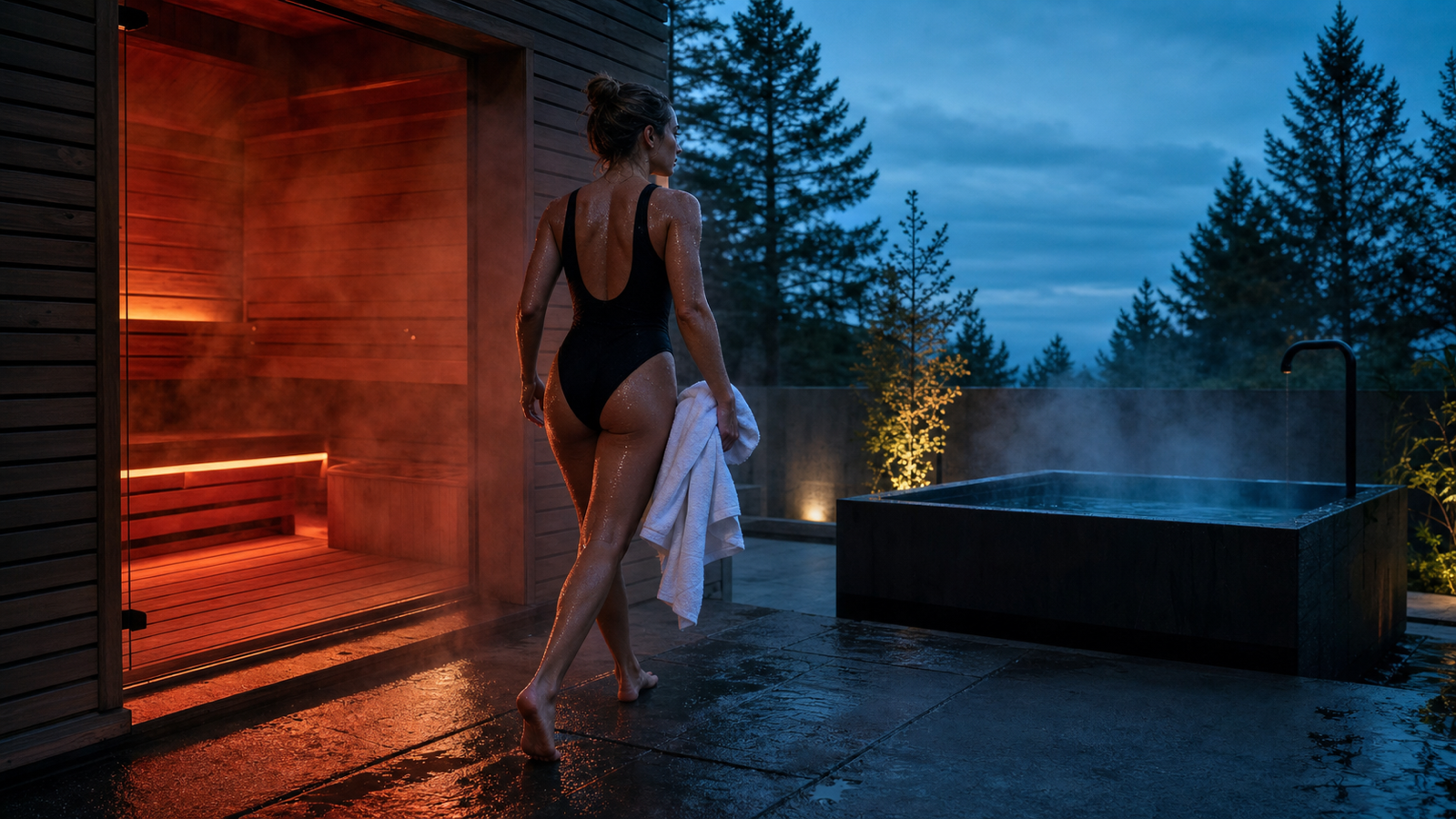
A cold plunge after sauna creates a rapid change from heat to cold. Some people enjoy that contrast, but there is no single evidence-based sequence, transition time, or water temperature that is right for everyone.
The change itself can be demanding. Sauna raises skin temperature and heart rate, while cold water can trigger gasping, faster breathing, blood-vessel constriction, and increased cardiovascular workload.
If you use both, treat the transition as part of the session. Leave the sauna under control, pause long enough to assess how you feel, enter the water deliberately, and keep the first cold exposure conservative. The useful question is not whether hot-to-cold contrast is universally good. It is whether your sequence is controlled, repeatable, and appropriate for you.
Why the hot-to-cold transition matters
Sauna and cold water ask the body to regulate temperature in opposite directions. In a sauna, skin blood flow and sweating help release heat. Heart rate commonly rises as the body manages that heat load. Cold-water immersion quickly cools the skin and narrows peripheral blood vessels. The first moments can also provoke an involuntary gasp and faster breathing.
Moving directly from one strong temperature stimulus to another combines those demands. A small circulation study found that alternating sauna with ice-water immersion or a cool shower produced more cardiac strain than sauna or cold exposure alone. Newer research also shows that the details matter: sauna temperature, time in heat, cooling method, water temperature, immersion depth, and participant health all change the response.
That does not mean every sauna-to-plunge routine is unsafe. It means the transition should not be treated as an empty gap between two independent activities.
Sauna first or cold plunge first?
For the familiar hot-to-cold experience, sauna comes first and the plunge becomes the cooling phase. The sequence is simple: heat, leave the sauna, cool down, then recover. It is also straightforward to define and log.
Starting cold and finishing in the sauna creates a different session. The sauna becomes a rewarming phase rather than preparation for cold. That may feel more comfortable, but it is not interchangeable with finishing cold, and research on one sequence should not be used to promise outcomes for the other.
Choose the order based on what you are trying to do, then keep it consistent enough to compare. If you change the order, record it as a different protocol rather than treating every contrast session as equivalent.
| Sequence | Practical role of the second step | Useful tracking detail |
|---|---|---|
| Sauna, then plunge | Cold water becomes the cooling phase | Transition time and plunge temperature |
| Plunge, then sauna | Sauna becomes the rewarming phase | Time between cold exit and sauna entry |
| Repeated rounds | Each round adds cumulative heat and cold exposure | Total time, number of rounds, and ending phase |
How long should you wait after sauna?
There is no universal waiting period supported by strong evidence. A practical transition is long enough to leave the sauna safely, stand or sit without feeling faint, take a normal breath, and approach the plunge deliberately.
Do not race from the hottest part of the sauna into the coldest water. A dramatic transition may feel impressive, but intensity is not proof of usefulness. If you feel lightheaded, nauseated, unusually weak, confused, or unable to control your breathing, skip the plunge and recover in a safer environment.
For a first combined session, a short air-cooling pause makes it easier to notice whether the sauna itself has already become too demanding. Experienced users may choose a shorter transition, but familiarity does not remove cardiovascular or fall risk.
How cold should the plunge be after sauna?
The water does not need to be near freezing. Research protocols vary widely. A 2026 study of healthy adults used 20°C / 68°F water for 90 seconds during sauna cooling breaks. That is much warmer than many commercial plunge settings, yet it still changed thermal and cardiovascular responses compared with air cooling alone.
This is a useful reminder: hot skin can make moderately cool water feel intensely cold. Begin with water you can enter without panic, keep your face above water, and avoid combining the hottest sauna, coldest plunge, and longest duration in one experiment.
If the water gets colder, shorten the exposure and pay more attention to the first minute. For broader context, read Cold Plunge Temperature and Time.
How long should the cold plunge last?
There is no universal duration for a post-sauna plunge. The stopping point depends on water temperature, immersion depth, sauna exposure, experience, health context, and how controlled the transition feels.
A timer is useful because heat and cold can distort your sense of time. Set a conservative goal before entering, but treat it as a ceiling rather than a challenge. Exit sooner if breathing remains uncontrolled, coordination worsens, you feel chest discomfort, or the session stops feeling deliberate.
Do not assume that repeating hot and cold rounds makes the routine proportionally better. Each round adds more total exposure. Track the number of rounds and cumulative time rather than only the final plunge. For more duration context, see How Long Should You Stay in a Cold Plunge?.
A conservative first hot-to-cold session
For a beginner, simplicity is more useful than an elaborate contrast protocol:
- use a moderate sauna rather than chasing maximum heat
- leave while you still feel coordinated and clear-headed
- pause in a safe area and assess how you feel
- use a measured, manageable water temperature
- enter gradually and keep your face above water
- set a short timer before entering
- exit while breathing and movement remain controlled
- dry off, recover, and avoid immediately adding another round
Change one variable at a time in later sessions. If you increase sauna time, keep the plunge familiar. If you lower the water temperature, do not also extend the duration. This makes the routine easier to interpret and reduces accidental escalation.
What to track
A contrast session has more moving parts than a plunge alone. A useful record includes:
- sauna type and approximate temperature
- time spent in the sauna
- transition time before the plunge
- plunge water temperature
- plunge duration and immersion depth
- whether the session ended hot or cold
- number of rounds
- hydration and recent exercise context
- short notes on breathing, dizziness, comfort, and recovery
The goal is not to create a laboratory record. It is to distinguish one routine from another. “Sauna and plunge” is too vague to explain why two sessions felt different.
Cold Plunge Timer & Log can time the cold portion and save water temperature, notes, history, stats, and streaks. Use the notes field for sauna time, transition, and round count. The app organizes your record; it does not decide whether a contrast routine is medically appropriate.
Common mistakes
The first mistake is treating discomfort as the goal. A stronger shock does not prove a better session.
The second is changing every variable at once. Longer sauna time, colder water, a faster transition, and more rounds make it difficult to know what caused the response.
The third is ignoring cumulative exposure. Three short rounds may create more total strain than one controlled round.
The fourth is using cold water to push through warning signs from heat. A plunge is not a treatment for feeling faint, confused, or unwell after sauna.
The fifth is copying a public figure's protocol without matching their environment, experience, health context, or supervision.
Safety note
Cold exposure and sauna use are not appropriate for everyone. This article is not medical advice, diagnosis, treatment, personalized safety guidance, or emergency support.
Heat can increase heart rate, sweating, fluid loss, and lightheadedness. Sudden cold-water immersion can trigger gasping, hyperventilation, peripheral vasoconstriction, and increased cardiovascular workload. Combining heat and cold may be particularly demanding for people with cardiovascular conditions, blood-pressure concerns, fainting history, pregnancy, medication effects, or other relevant health conditions.
Avoid using either activity alone, intoxicated, or in an environment where a fall or loss of coordination would be dangerous. Keep your face above water, use a clear entry and exit, and stop if you develop chest discomfort, severe breathlessness, confusion, faintness, or loss of control. If you are unsure whether sauna or cold-water immersion is appropriate for you, speak with a qualified health professional.
Do not rely on an article, app, timer, or tracking system during an emergency.
FAQ
Should you cold plunge immediately after sauna?
Not necessarily. There is no universal evidence-based transition time. Pause long enough to leave safely, assess how you feel, and enter deliberately. Skip the plunge if you feel faint, confused, unwell, or unable to recover normally from the heat.
Is sauna first or cold plunge first better?
Neither order is universally better. Sauna first creates a hot-to-cold cooling sequence. Plunge first makes sauna the rewarming phase. Choose one based on your purpose and keep the order consistent enough to compare sessions.
How cold should a plunge be after sauna?
It does not need to be near freezing. Hot skin can make moderately cool water feel intense. Start conservatively, measure the water, and avoid combining maximum sauna heat with extreme cold.
How long should you cold plunge after sauna?
There is no universal duration. Water temperature, immersion depth, sauna exposure, experience, and health context all matter. Use a conservative timer goal and exit sooner if breathing, coordination, or comfort deteriorates.
How many sauna and cold plunge rounds should you do?
There is no required number. One controlled round is easier to assess than several escalating rounds. If you repeat the sequence, track cumulative sauna time, cold exposure, and how you recover.
What should you track in a sauna and cold plunge routine?
Track sauna time and temperature, transition time, plunge temperature and duration, number of rounds, sequence, and short notes about breathing and recovery.
References
- Owen TF, Giles CJ, Leaney SF, Coombs GF, Oliver SJ. Thermal and cardiovascular responses to sauna are attenuated by adding cold water immersion to cooling breaks. Experimental Physiology. 2026. https://pubmed.ncbi.nlm.nih.gov/42390474/
- Kauppinen K. Sauna, shower, and ice water immersion. Physiological responses to brief exposures to heat, cool, and cold. Part II. Circulation. Arctic Medical Research. 1989. https://pubmed.ncbi.nlm.nih.gov/2736002/
- Knechtle B, et al. Health effects of voluntary exposure to cold water: a continuing subject of debate. International Journal of Circumpolar Health. 2022. https://pmc.ncbi.nlm.nih.gov/articles/PMC9518606/
- Shattock MJ, Tipton MJ. Autonomic conflict: a different way to die during cold water immersion? The Journal of Physiology. 2012. https://pmc.ncbi.nlm.nih.gov/articles/PMC3459038/