
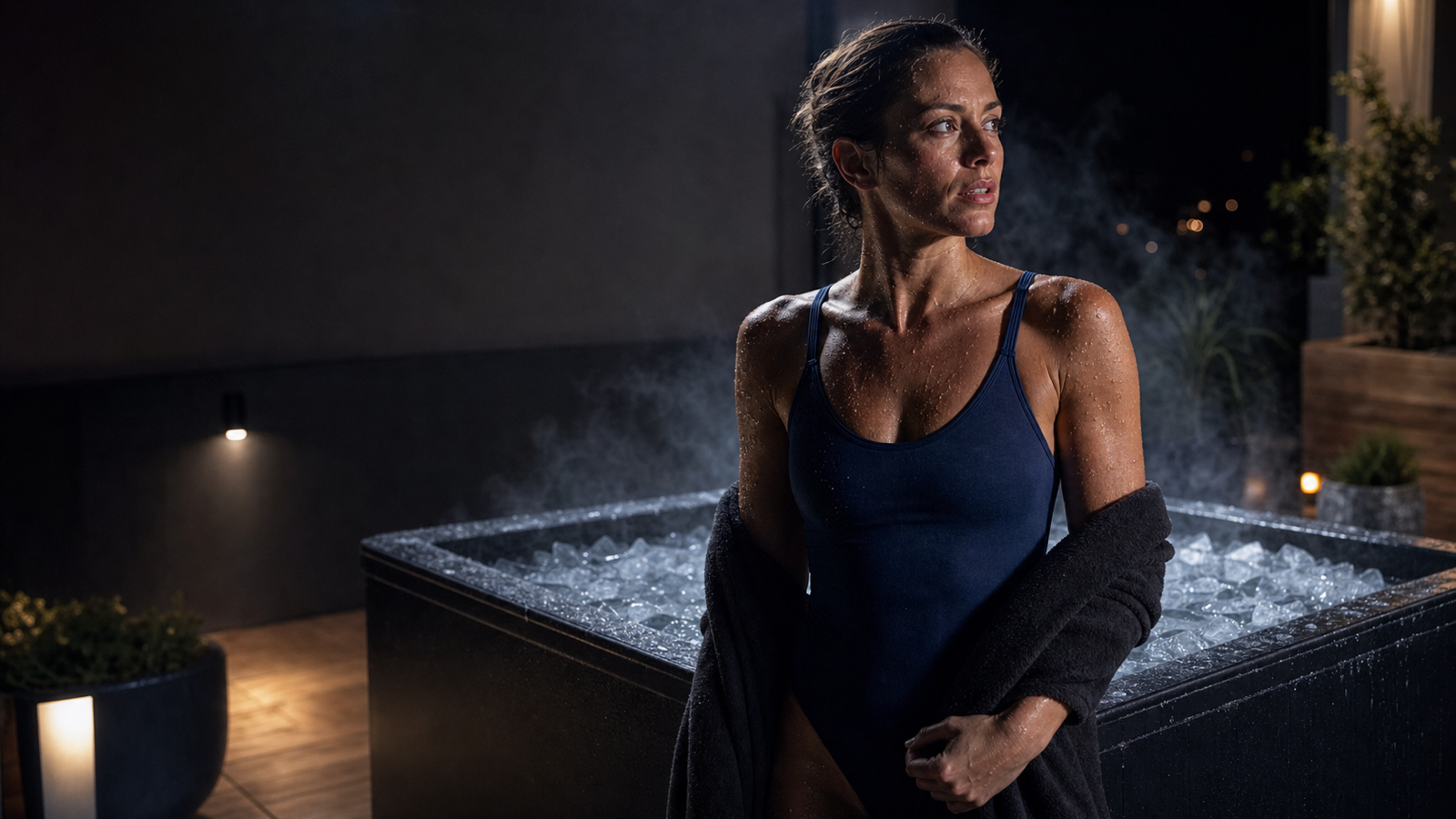
A cold plunge before bed may feel calming for some people and too stimulating for others. The practical answer is not that nighttime cold exposure is always good or always bad for sleep. It depends on the water temperature, session length, timing, your experience, and how your body responds afterward.
If a cold plunge leaves you relaxed and ready to wind down, it may fit your evening routine. If it leaves you alert, tense, or restless, it may be better earlier in the day.
This guide explains why cold plunging at night is nuanced, how to try it conservatively, and what to track before deciding whether it belongs near bedtime.
Why the simple answer is not enough
Sleep is closely connected to body temperature, nervous-system state, stress, light exposure, caffeine, training load, and routine timing. Cold water adds another strong input to that system.
Warm bathing before bed has more direct sleep research behind it than cold plunging before bed. A 2019 review on passive body heating found that warm baths or showers before bedtime can support sleep outcomes for some people, likely because warming the body can help with later heat loss. Cold plunging is different. It is a sharper stimulus and can feel energizing.
That does not mean cold water at night is wrong. It means you should judge it by your own response, not by a universal rule.
Cold plunges can feel calming or alerting
Some people describe evening cold plunges as a reset. The session is short, the routine is clear, and the contrast between discomfort and relief can feel mentally clean.
Other people feel the opposite. Cold water can increase breathing intensity, raise alertness, and make the body feel switched on. If that happens near bedtime, sleep may feel harder.
Both responses are plausible. The useful question is not whether cold plunging before bed is good in general. The useful question is whether your specific session helps your night routine.
Timing matters
A cold plunge right before lights out is a different experiment than a cold plunge two or three hours before bed. The closer the session is to bedtime, the more important it is to avoid making it extreme.
If you want to test nighttime cold exposure, start earlier in the evening rather than immediately before sleep. Keep the first sessions short and moderate. Then compare how you feel after the session and the next morning.
If you feel wired, chilled, restless, or unusually alert afterward, move the session earlier, shorten it, raise the water temperature, or save cold plunges for another part of the day.
Temperature matters even more at night
Temperature changes the entire bedtime question. A short session in moderately cold water is not the same as a longer session in very cold water.
If you are experimenting with cold plunges before bed, colder is not automatically better. Very cold water can make breathing and tension harder to control, especially for beginners.
A useful way to think about it is simple: if the water gets colder, make the session shorter or move it earlier. Do not lower the temperature, increase duration, and place the session closer to bedtime all at once.
For more context, read Cold Plunge Temperature and Time.
Duration should stay conservative
Nighttime is not the best place to prove endurance. If your goal is sleep, the session should support your routine, not dominate it.
Keep duration short enough that you exit controlled. If you notice you are chasing a longer time even though your breathing, tension, or alertness is climbing, the timer is working against the point of the routine.
A cold plunge timer is useful because it removes guessing. It should not become pressure. For bedtime sessions, the best timer goal is one you can repeat without feeling overstimulated afterward.
For duration context, see How Long Should You Stay in a Cold Plunge?.
A beginner-friendly way to test it
If you are new to cold exposure, do not start with a hard nighttime plunge. Start with a simple, repeatable test.
One conservative approach is:
- try the session earlier in the evening
- use moderate cold rather than extreme cold
- set a short timer before getting in
- keep your face above water
- stop if breathing does not settle
- write a short note after the session
- check the next morning whether sleep felt better, worse, or unchanged
Repeat the same basic setup a few times before drawing conclusions. One night can be noisy. A few logged sessions can show a clearer pattern.
What to track
A bedtime cold plunge is one of the best examples of why tracking matters. The value is not only knowing that you plunged. It is knowing what kind of plunge you did and how the night went afterward.
Useful fields include:
- session time
- duration
- water temperature
- how controlled your breathing felt
- whether the session felt calming or alerting
- sleep note the next morning
- any workout, sauna, caffeine, or high-stress context that day
Cold Plunge Timer & Log can help with the timing and logging side: timer, water temperature, notes, history, stats, and streaks. It does not decide whether nighttime cold exposure is medically right for you. It helps you keep a clear record of what you tried.
Common mistakes
The first mistake is treating bedtime cold plunges as automatically relaxing. They may be relaxing for some people, but the cold itself can be stimulating.
The second mistake is going too cold too soon. If sleep is the goal, intensity is not the point.
The third mistake is testing too many changes at once. If you change temperature, duration, bedtime, caffeine, workout timing, and sauna use in the same week, you will not know what affected your sleep.
The fourth mistake is ignoring next-morning feedback. If you consistently feel restless at night or flat the next day, the routine needs adjustment.
Safety note
Cold exposure is not appropriate for everyone. This article is not medical advice, diagnosis, treatment, personalized safety guidance, or emergency support.
Cold water can stress breathing and the cardiovascular system, especially with sudden immersion, very cold temperatures, longer exposure, open water, existing medical conditions, or high cumulative stress. If you are unsure whether cold exposure is appropriate for you, speak with a qualified health professional.
Do not rely on an article, app, timer, or tracking system during an emergency.
FAQ
Is it good to cold plunge before bed?
It depends. Some people find a short evening cold plunge calming, while others feel more alert afterward. Start conservatively and track how your sleep responds.
Can a cold plunge hurt sleep?
It can for some people, especially if the water is very cold, the session is long, or it happens too close to bedtime. Feeling wired afterward is a sign to move it earlier or make it easier.
How long before bed should you cold plunge?
There is no universal timing rule. A practical approach is to avoid experimenting with intense cold right before lights out and track whether earlier timing works better for you.
Should beginners cold plunge at night?
Beginners should keep nighttime sessions short, controlled, and moderate. If cold exposure makes breathing, heart rate, or alertness feel too high, it is better to stop and try a simpler routine.
What should I track if I cold plunge before bed?
Track duration, water temperature, session time, notes about how controlled it felt, and a simple sleep note the next morning.
References
- Haghayegh S, Khoshnevis S, Smolensky MH, Diller KR, Castriotta RJ. Before-bedtime passive body heating by warm shower or bath to improve sleep: A systematic review and meta-analysis. Sleep Medicine Reviews. 2019.
- Tipton MJ. Moving in extreme environments: open water swimming in cold and warm water. Extreme Physiology & Medicine. 2014. https://pmc.ncbi.nlm.nih.gov/articles/PMC4052348/
- The effects of cold-water immersion on health and wellbeing: A systematic review and meta-analysis. PLOS One. 2025. https://pmc.ncbi.nlm.nih.gov/articles/PMC11778651/
- Mayo Clinic Press. The science behind ice baths for recovery. https://mcpress.mayoclinic.org/healthy-aging/the-science-behind-ice-baths-for-recovery/