
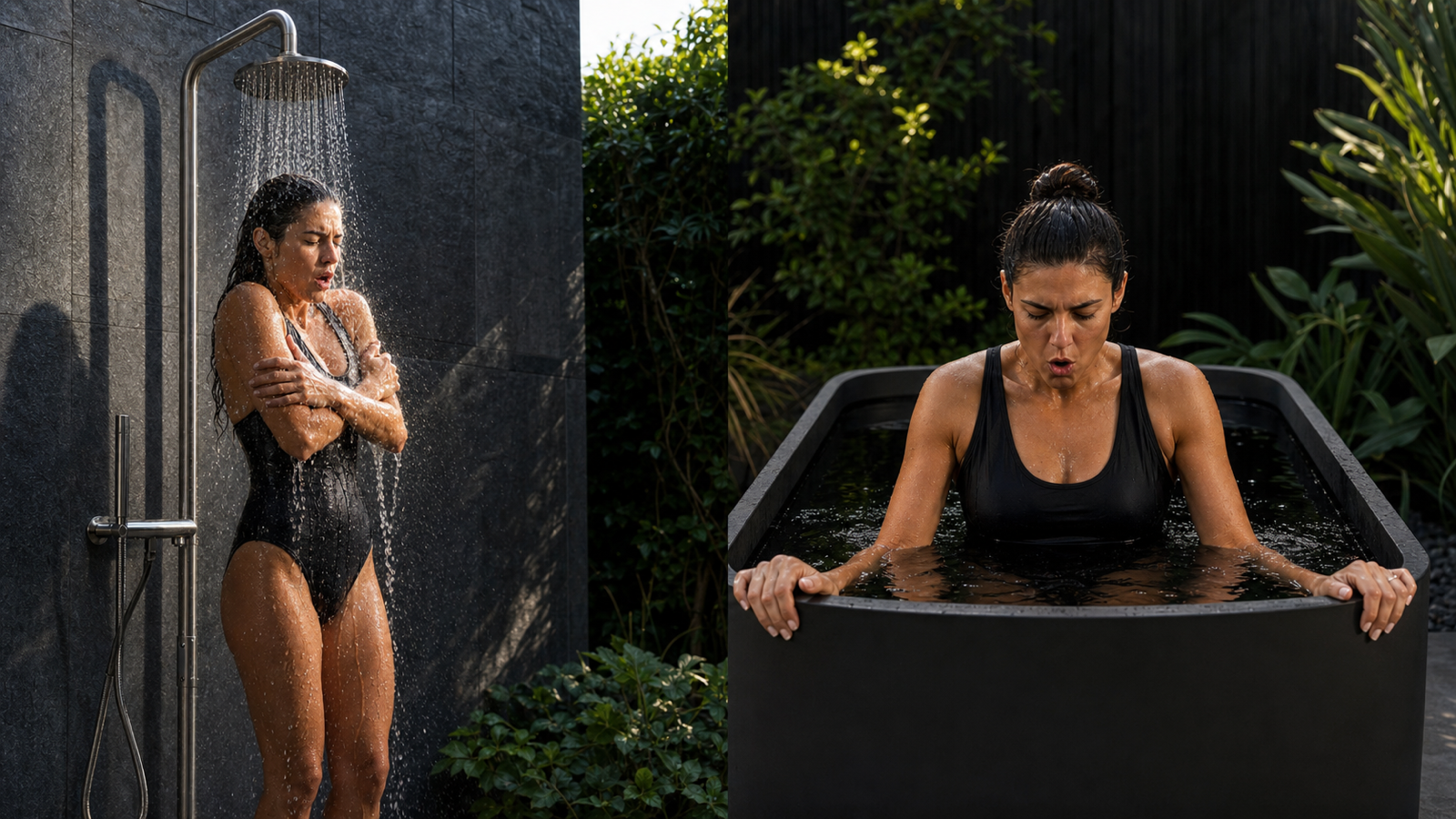
A shower moves water across selected parts of the body. A plunge immerses a larger, more consistent area at once. That difference affects intensity, measurement, and repeatability.
A cold shower is inexpensive and easy to try. A cold plunge offers better control over water temperature, immersion depth, and session comparison. Neither is automatically better; the practical choice depends on your space, budget, and reason for using cold water.
The short answer
Choose a cold shower if you want to experiment with cold water using equipment you already have. You can control the duration and move out of the stream quickly, but the temperature and amount of body exposure may be difficult to repeat.
Choose a cold plunge if you want a more defined session. A tub makes it easier to immerse the same amount of your body, measure the water temperature, time the session, and compare one entry with another. The tradeoffs are cost, space, preparation, cleaning, and maintenance.
A 60-second cold shower should not be treated as equivalent to a 60-second plunge at a measured temperature.
What counts as a cold shower?
A cold shower is usually a regular shower with the water set cold for part or all of the session. Some people begin warm and finish cold; others use cold water from the start.
The exposure is uneven by design. Moving around changes how much skin is under the stream. Water pressure, shower head coverage, plumbing, season, and the tap setting can all change the experience.
That variability makes a shower accessible, but it also limits measurement. The coldest tap position in one home may differ from another and change across the year.
What counts as a cold plunge?
A cold plunge immerses part of the body in cold water, usually in a tub, barrel, bath, stock tank, or purpose-built plunge.
Once seated, the coverage is more consistent than standing under a shower stream. A thermometer gives the session a measured temperature, while the water line indicates immersion depth.
A plunge does not require a chiller or near-freezing water. A bathtub filled with cool water can still be a controlled immersion setup. Dedicated equipment mainly changes preparation, filtration, and temperature control. What matters is whether you can describe the temperature, duration, depth, and conditions.
Cold plunge vs cold shower at a glance
| Factor | Cold shower | Cold plunge |
|---|---|---|
| Body exposure | Selected areas under a moving stream | Larger submerged area exposed at once |
| Temperature | Often difficult to measure and repeat | Easier to measure with a water thermometer |
| Duration | Simple to time | Simple to time |
| Setup | Uses an existing shower | Requires a tub, water, and sometimes ice or a chiller |
| Exit | Step away or change the tap | Stand up and leave the tub using a clear exit |
| Cost | Usually little or no added equipment | Ranges from a basic bath to a dedicated system |
| Maintenance | Normal bathroom cleaning | Water care, cleaning, draining, or filtration may be needed |
| Tracking | Duration and shower setting are most practical | Duration, temperature, depth, and notes can be compared |
| Repeatability | Can vary with plumbing, position, and season | Usually easier to standardize |
These are practical differences, not promised health outcomes. Findings from immersion research should not automatically be applied to a home shower.
Does a cold plunge feel more intense?
It often can because more of the body is exposed at once. But intensity is not determined by the method's name alone.
A very cold, high-flow shower may feel more demanding than a moderately cool bath. Temperature, exposed area, duration, immersion depth, experience, and surrounding air all matter.
A 2025 systematic review included showers and immersion, but the protocols varied considerably. That makes it unwise to assume every cold-water method produces an equivalent response. Do not use discomfort as a measuring instrument; record what you can observe.
Which is better for beginners?
For many beginners, a cold shower has the lower barrier to entry. It requires no new equipment and lets you explore a brief exposure without filling a tub.
A plunge can also be a reasonable beginner setup when the temperature is measured, the duration is conservative, and the exit is clear. Its variables are easier to compare.
The better first option removes avoidable uncertainty. Use a consistent shower setting or begin a plunge with manageable water rather than chasing extreme cold. For first-immersion preparation, read Your First Cold Plunge: A Practical Beginner's Guide.
When a cold shower makes more sense
A cold shower may make sense when:
- you want to try cold water without buying equipment
- you have limited space
- filling and maintaining a tub would make consistency difficult
- you prefer a brief cold finish to a normal shower
Its main limitation is measurement. You can time the cold portion, but temperature and exposure may vary. A note such as “coldest tap setting, full stream, upper body” is more useful than guessing a temperature.
When a cold plunge makes more sense
A cold plunge may make sense when:
- you want to measure water temperature
- you want consistent immersion depth
- you want to compare sessions over time
- you have a safe tub and can manage its upkeep
A dedicated system is not required. A basic tub, thermometer, timer, and consistent fill level can create a useful record.
If you are comparing an ice-filled bath with dedicated equipment, read Ice Bath vs Cold Plunge: What's the Difference?.
What to track for each method
A timer is useful for both methods, but the log should reflect what you can measure.
For a cold shower, save:
- cold-water duration
- date and time
- whether the session started warm or cold
- approximate shower setting
- areas kept under the stream
- a short note about how controlled it felt
For a cold plunge, save:
- immersion duration
- measured water temperature
- date and time
- approximate immersion depth
- setup or location
- a short note about how controlled it felt
Tracking adds context. “That felt colder” may reflect temperature, immersion depth, duration, or setup.
Cold Plunge Timer & Log is designed around plunge sessions: time the session, save measured temperature and notes, and review history, stats, and streaks. A shower can still be timed, but an unmeasured setting should not become a precise temperature.
For a complete logging workflow, see How to Track Cold Plunge Sessions.
Common comparison mistakes
- Treating equal durations as equal exposure.
- Borrowing immersion research to promise results from showers.
- Assuming colder water is automatically better.
- Buying equipment before knowing whether the routine fits.
- Recording a guessed temperature as if it were measured.
Use measured values when you have them and useful descriptions when you do not.
Safety note
Cold exposure is not appropriate for everyone. This article is not medical advice, diagnosis, treatment, personalized safety guidance, or emergency support.
Sudden immersion can provoke gasping, rapid breathing, increased heart rate, and increased blood pressure. It also introduces risks a home shower may not, including difficulty exiting and drowning. Avoid breath-holding or deliberate hyperventilation in or near water.
Use a stable setup with a clear exit. Stop if you feel unwell or cannot keep the session controlled. Speak with a qualified health professional if you are unsure whether cold exposure is appropriate for you.
Do not rely on an article, app, timer, or tracking system during an emergency.
FAQ
Is a cold shower the same as a cold plunge?
No. Both use cold water, but a shower directs moving water onto selected areas while a plunge immerses a larger part of the body. Temperature, coverage, and repeatability differ.
Is a cold plunge better than a cold shower?
Not universally. A shower is easier and less expensive to try. A plunge is easier to measure and repeat. The better choice depends on your setup, budget, and reason for using cold water.
Can a cold shower prepare you for a cold plunge?
A cold shower can introduce brief cold-water exposure, but it does not reproduce full immersion. Treat a first plunge as a different session.
How long should a cold shower or cold plunge last?
There is no universal duration. Temperature, exposed area, experience, and health context matter. Start conservatively and do not ignore warning signs for a timer target.
Can I track a cold shower with a cold plunge timer?
You can time the cold portion of a shower and save a note about the setup. Avoid recording a precise water temperature unless you measured it.
Is this medical advice?
No. This article provides general educational information and is not medical advice, diagnosis, treatment, personalized safety guidance, or emergency support.
References
- Buijze GA, Sierevelt IN, van der Heijden BCJM, Dijkgraaf MG, Frings-Dresen MHW. The Effect of Cold Showering on Health and Work: A Randomized Controlled Trial. PLOS ONE. 2016.
- Cain MK, Brinsley J, Bennett H, Nelson M, Maher C, Singh B. Effects of cold-water immersion on health and wellbeing: A systematic review and meta-analysis. PLOS ONE. 2025.
- Espeland D, de Weerd L, Mercer JB. Health effects of voluntary exposure to cold water: a continuing subject of debate. International Journal of Circumpolar Health. 2022.
- Tipton MJ, Collier N, Massey H, Corbett J, Harper M. Cold water immersion: kill or cure?. Experimental Physiology. 2017.